
Your team has a communication problem. People agree in meetings but complain afterward. Feedback is vague because nobody wants to be "that person." A client pushes back on a timeline and nobody on your team pushes back in return. The project slips. The team resents the client. The client has no idea anything was wrong because nobody said anything.
These are assertiveness problems. Most teams solve them by ignoring them or hoping people "figure it out." This template takes a different approach: six practical exercises that teach assertive communication through doing, not just reading. Each exercise is a card with a description explaining the concept and a checklist of concrete actions to complete. Move cards from To Do to Doing to Done as your team works through each one.
What is in this template
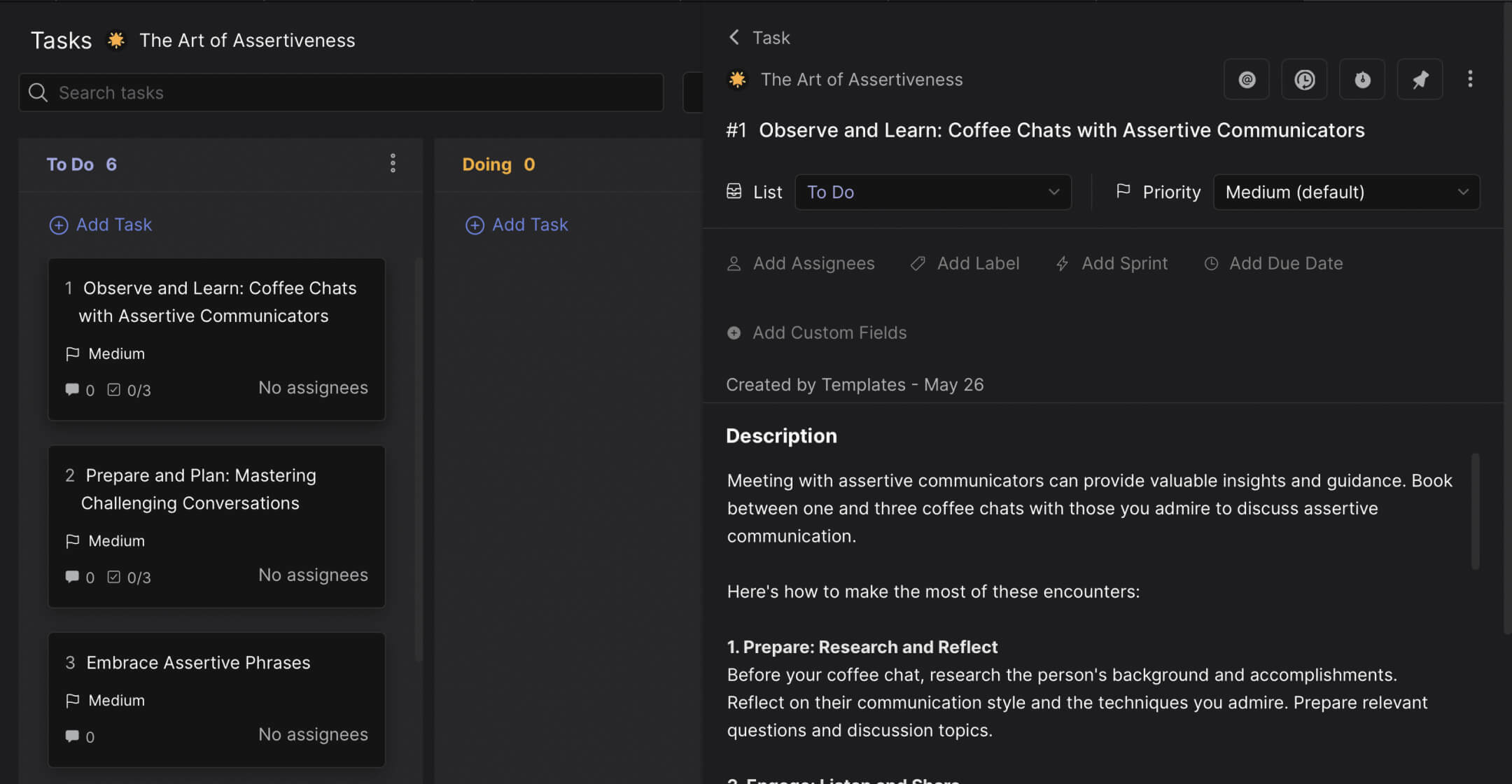
The board has three columns (To Do, Doing, Done) with six exercise cards. Each card is a mini-lesson and an action combined.
Coffee Chats with Assertive Communicators. Book 1-3 meetings with people you admire for their communication confidence. Prepare questions, listen to their experiences, ask for specific examples, request feedback on your own style, and apply what you learned. Learning assertiveness from someone who practices it is more effective than reading about it.
Prepare for Challenging Conversations. Pick 3 upcoming difficult conversations and prepare for each one using an 8-step framework: define your goals, identify key points, anticipate objections, rehearse, choose the right time and place, practice active listening, stay flexible, and reflect afterward. Preparation transforms anxiety into confidence.
Embrace Assertive Phrases. Replace passive language with assertive alternatives. Seven categories of "I" statements: express opinions ("I believe," "I think"), state preferences ("I would like," "I prefer"), set boundaries ("I cannot," "I need"), assert rights ("I have the right to," "I deserve"), offer solutions ("I suggest," "What if we"), and request clarification ("Can you please explain"). Practice these in daily conversations until they feel natural.
Give and Receive Constructive Feedback. Schedule 3 reciprocal feedback meetings with coworkers, clients, or partners. Use a 7-step framework: focus on behavior not personality, be specific with examples, use "I" statements, offer solutions, be timely, receive criticism gracefully, and reflect on the feedback afterward. The template includes concrete examples for each step. For more on structuring effective feedback in creative work, the same principles apply.
Watch TED Talks. Five curated talks with application notes: Brene Brown on vulnerability, Amy Cuddy on body language and confidence, Julian Treasure on speaking so people listen, Susan David on emotional courage, and Celeste Headlee on having better conversations. Each talk comes with instructions: take notes, reflect on how it applies to your situation, implement one suggestion, and share with a colleague.
Daily Affirmations. A 4-step process: choose relevant affirmations ("I am confident in expressing my needs," "My opinions are valid"), personalize them to your specific situation, practice consistently at the same time each day, and use multiple modalities (say them, write them, post them). This card is designed for ongoing practice, not a one-time exercise.
"Assertiveness is not about being aggressive. It is about expressing your thoughts, feelings, and needs clearly and respectfully. Most people confuse the two, which is why they avoid assertiveness altogether." - Brene Brown, Author, Dare to Lead
Why this is a workshop, not a course
Courses teach you about assertiveness. Workshops make you practice it. The difference matters because assertiveness is a skill, not knowledge. You cannot become assertive by watching videos any more than you can learn to swim by reading about water.
Each card in this template includes a specific number of practice exercises: 3 coffee chats, 3 conversation preparations, 3 feedback meetings, 5 TED Talks. These numbers are intentional. One practice session is a try. Three is a pattern. By the time you have prepared for three challenging conversations, you have a framework you can use for every future one.
According to Harvard Business Review research, people who practice assertive communication in structured exercises show measurably improved confidence within 4-6 weeks. The key is structured practice, not more theory. This template provides the structure.
What we do at Rock: the workshop board lives in a shared space where the team discusses each exercise. When someone completes a coffee chat and shares what they learned, the insight goes on the card as a comment. When someone prepares for a difficult conversation and it goes well, they share the outcome. The team learns together. Good communication strategies are built through practice, not just training.
"The most important thing in communication is hearing what is not said. Assertive communication teaches you to say what needs to be said, so your team does not have to guess." - Peter Drucker
Who this template is for
Best for: Team leads who notice passive communication patterns (people avoiding conflict, giving vague feedback, not pushing back on unreasonable requests). HR managers looking for a practical team development activity that does not require hiring an external trainer. Remote teams where communication problems are amplified by the lack of in-person cues.
Skip this if: Your team already communicates assertively and handles difficult conversations well. Or if you need clinical-level assertiveness training for specific individuals (that requires a professional coach, not a template).
Tips for running this as a team
Do one exercise per week. The template has 6 exercises, so the workshop takes about 6 weeks. That cadence gives each person time to complete the practice activities (3 coffee chats, 3 conversation preps, 3 feedback meetings) without it feeling rushed.
Start with "Watch TED Talks" if the team is skeptical. It is the lowest-friction exercise. Nobody has to have a difficult conversation or give feedback to a colleague. They just watch 5 talks and share one takeaway. Once the team sees the value, the more challenging exercises (feedback meetings, challenging conversations) feel less intimidating.
"Assertiveness is a skill you practice, not a personality trait you are born with. Anyone can learn it. The only question is whether they are willing to feel uncomfortable for a few weeks while the new behavior becomes natural." - Amy Cuddy, Social Psychologist, Harvard Business School
Celebrate when cards move to Done. Each completed exercise represents a real change in how someone communicates. A team member who prepared for and successfully navigated a challenging conversation has grown. Acknowledge that publicly. The board's Done column is not just a record. It is proof that your team is getting better at the thing most teams avoid.


