
Your team is busy. Every day is full of meetings, messages, and tasks. But at the end of the week, the important projects have barely moved. The problem is not that people are not working hard. It is that the team has not distinguished between working efficiently (doing things faster) and working effectively (doing the right things). Most productivity advice mixes the two together. This template separates them.
Fourteen strategies organized across three categories: efficiency, effectiveness, and the combination of both. Each strategy is a card with a detailed description explaining why it matters and a checklist of concrete actions to implement it. Move cards to Done as your team tests and adopts each practice. It is not a productivity app. It is a productivity course your team completes together.
What is in this template
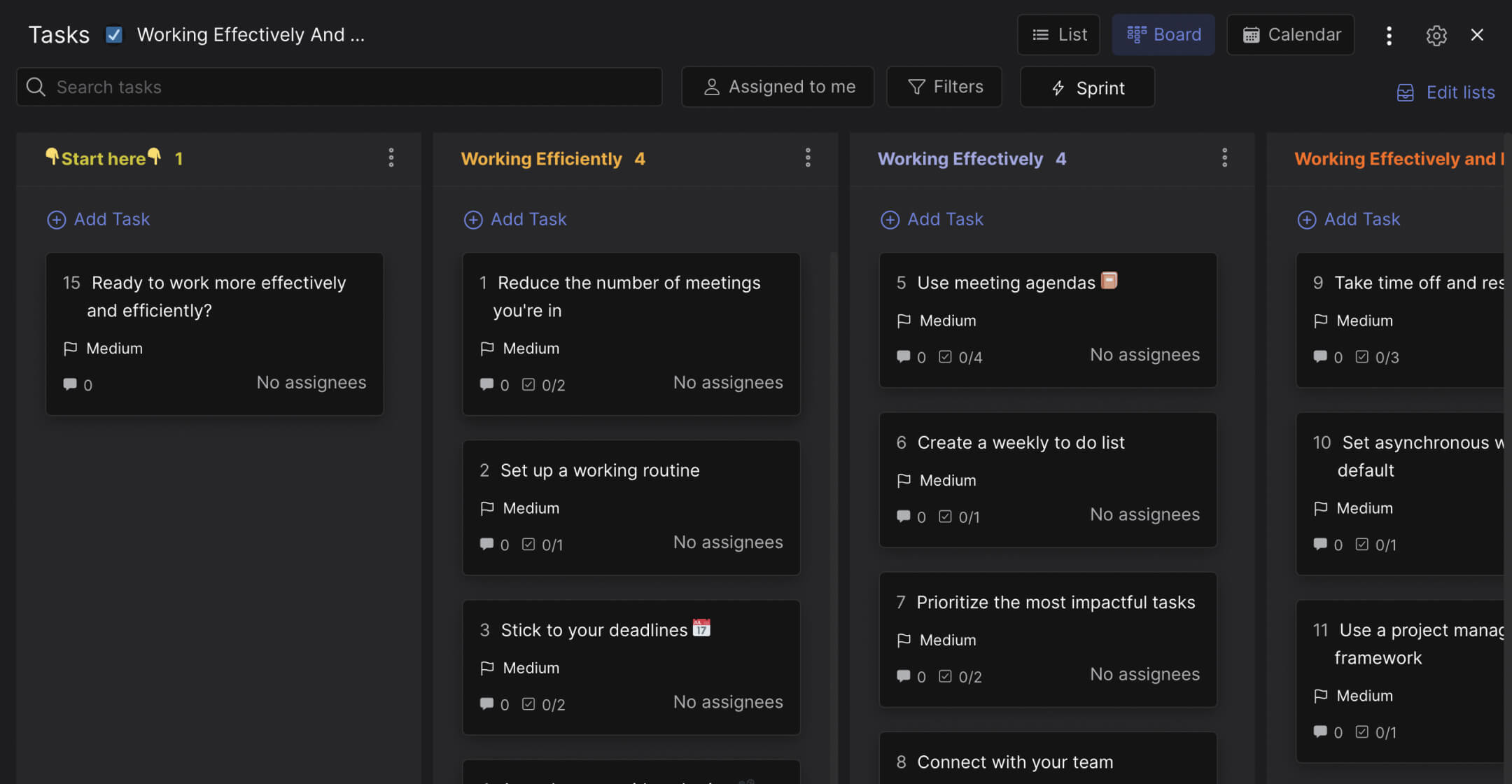
The board has four columns that progress from learning to implementation.
Preview: Productivity Training Board
14 strategies from efficiency to effectiveness. Drag cards to try it.
Drag cards between columns or add your own
Tap a card, then tap a column header
Working Efficiently. Four strategies for doing things faster without adding more hours. Reduce unnecessary meetings (executives spend 23 hours per week in meetings, up from under 10 in the 1960s). Set up a consistent working routine that matches when you are most productive. Stick to deadlines as a prioritization tool, not a stress source. Use asynchronous video sharing to replace presentations and onboardings that do not need to be live. Each card includes a checklist: implement meeting agendas, test Loom for async video, build a morning routine.
Working Effectively. Four strategies for doing the right things. Use meeting agendas so every meeting has a purpose and preparation time. Create weekly to-do lists that break large projects into achievable tasks. Prioritize the most impactful work using urgency and importance filters. Connect with your team through trust, open feedback, and recognition. These cards focus on quality of output, not speed.
Working Effectively and Efficiently. Six strategies that combine both dimensions. Take time off and rest (your brain is a muscle that needs recovery). Set asynchronous work as your default collaboration mode. Adopt a project management framework (Agile vs Waterfall, choose what fits). Implement task management with deadlines, priorities, and team visibility. Use documentation to reduce time searching for information. Consolidate tools to stop context-switching between platforms.
"Efficiency is doing things right. Effectiveness is doing the right things. The best teams do both, but they start by knowing the difference." - Peter Drucker
Why most productivity advice fails
Most productivity content is a list of tips: "use a to-do list," "time-block your calendar," "automate repetitive tasks." The problem is not that the tips are wrong. The problem is that they are not organized into a framework that helps teams decide what to implement first and why.
This template solves that by separating efficiency from effectiveness. A team that reduces meetings (efficiency) but does not prioritize the right work (effectiveness) will get the wrong things done faster. A team that prioritizes well (effectiveness) but does not reduce overhead (efficiency) will work on the right things too slowly. You need both, and the board shows how they connect.
According to Harvard Business Review, 70% of meetings keep employees from doing productive work. That is an efficiency problem. According to Asana's Anatomy of Work Index, workers spend 58% of their time on "work about work." That is an effectiveness problem. This template addresses both.
What we do at Rock: the productivity board lives in a shared space where the team discusses each strategy before implementing it. When someone tests async video and reports back, the conversation is on the card. When the team agrees to reduce meetings by one per week, the decision is documented. The template becomes a living record of how your team decided to work. For more on improving team productivity, the 14 strategies in this template are the practical starting point.
"The goal is not to be busy. The goal is to be productive. And productive means different things for efficiency and effectiveness. You can be efficiently doing the wrong work all day." - Cal Newport, Author, Deep Work
Who this template is for
Best for: Team leads onboarding new remote employees who need to learn "how we work here." Agencies standardizing their operating practices as they grow from 5 to 20 people. Managers who want to improve team output without hiring a productivity consultant. Any team where "we are always in meetings but nothing gets done" is a common complaint.
Skip this if: You are looking for a personal productivity system (GTD, Pomodoro, time-blocking). This template is for teams, not individuals. For personal productivity, a simple task prioritization approach works better.
Tips for using this template
Do not try all 14 strategies at once. Start with the Efficiency column. Pick one strategy (reduce meetings is usually the highest impact), implement it for two weeks, then move the card to Done. Then pick the next one. Trying to change everything simultaneously creates more chaos, not less.
Make it a team exercise, not a manager mandate. Share the board with your team and let them pick which strategies to try first. When people choose their own productivity improvements, adoption is higher than when changes are imposed from above.
"You do not rise to the level of your goals. You fall to the level of your systems. Build the systems first, then pursue the goals." - James Clear, Author, Atomic Habits
Move cards to Done only after the strategy is tested and adopted. "We tried it once" is not Done. "We have been doing this for two weeks and it works" is Done. The board should reflect what your team actually does, not what they intended to do.


