Client Brief Template: 9 Sections You Can Copy
The client brief is the agency-internal document that translates discovery into team alignment. The IPA's guidance on briefing has been the industry reference for this document for over a decade. It answers "who is this client, what do they need, how do we deliver" in one short doc every team member can read in five minutes. Done well, it prevents the most common failure in a new engagement: every team member starting with a different version of the client in their head.
This guide covers the 9 sections every client brief should include and where each piece of information comes from (questionnaire, sales notes, contract). It also covers how to turn discovery into a brief without rewriting every time, and the mistakes that make briefs get ignored. Build your template with the widget below, copy it, and drop it into your doc.

Build Your Brief
Before the 9 sections, a tailored template. Answer three questions and the widget outputs a brief template you can copy into your team doc.
Build your client brief
Three answers, one tailored brief template. Copy the sections, fill in your own answers, send to the team.
Quick answer. A client brief is the agency's internal summary of a new client, written from the questionnaire answers and sales notes. It is team-facing (not sent to the client), lives in the shared client workspace, and covers who the client is, what success looks like, scope, timeline, risks, and how the team will work together. Different from a creative brief (which is for creative execution) and from the questionnaire (which is the client-facing input).
Client Brief vs Questionnaire vs Creative Brief
Most agency content treats these three documents as the same thing. They are not. Each serves a different moment in the engagement and a different audience. Knowing which one you are writing (and which one you are missing) is half the battle.
| Document | Direction | Purpose | When |
|---|---|---|---|
| Onboarding questionnaire | Agency → Client | INPUT. 15 questions the agency sends; client fills in the answers. | Day 1 to 3 of onboarding. |
| Client brief | Agency → Agency team | OUTPUT. Team-facing summary the agency writes up from questionnaire + sales notes. | Day 3 to 7, before kickoff. |
| Creative brief | Agency lead → Creative team | EXECUTION. Translates the client brief into creative direction for designers, writers, strategists. | After kickoff, before creative work starts. |
The mistake most agencies make is conflating the onboarding questionnaire with the client brief. The questionnaire is the INPUT (agency sends questions, client fills in). The client brief is the OUTPUT (agency writes up what it learned, used internally). Skipping the brief means every team member has to re-read the questionnaire themselves, which nobody does after month one. The brief is the condensed, interpreted version.
The 9 Sections Every Client Brief Needs
Every client brief should cover 9 sections. Some engagements add 1-3 more (service-specific or stakeholder-specific), but the core 9 apply to every agency engagement regardless of service type. Each section has a clear job and a clear source for where the input comes from.
| Section | What it answers | Where the input comes from |
|---|---|---|
| 1. Client snapshot | Who the client is in one paragraph: business, model, primary contact. | Sales notes, public research, questionnaire. |
| 2. Primary business outcome | The one metric this engagement most directly affects. | Questionnaire Q6, confirmed in kickoff. |
| 3. Success metrics | Specific, measurable targets at 30, 60, 90 days. | Questionnaire Q7 and Q8, tightened with client in kickoff. |
| 4. Stakeholder map | Decision makers, influencers, reviewers, users. | Questionnaire Q1, Q2, Q3. Sales often adds context. |
| 5. Scope of engagement | What is in scope, what is out, what is adjacent. | Contract, SOW, change order clause. |
| 6. Timeline and milestones | Key dates, phase gates, external deadlines. | Contract start date, questionnaire Q9, internal capacity plan. |
| 7. Brand context and assets | Existing brand system, inherited work, asset inventory. | Questionnaire Q11, sales deck, brand audit. |
| 8. Risks and watchouts | What could derail this engagement. | Sales notes (objections, red flags), questionnaire Q15, team gut. |
| 9. Working agreement and comms | Response times, revisions, change orders, cadence. | Working agreement doc, questionnaire Q13. |
Section 2 (primary business outcome) is the one most agencies get wrong. They list three or four "goals" rather than one primary outcome. A brief with multiple goals of equal weight is a brief with no real focus. Force the client (and the team) to pick one outcome the engagement is primarily for. Everything else is secondary context.
Section 8 (risks and watchouts) is the section agencies most often skip. It feels negative to write down what could go wrong. But sales notes almost always contain risk signals (objections, past vendor issues, budget pressure) that are gold for the team if captured. Skip this section and the risks surface later as surprises.
Writing the Brief From Existing Inputs
A good client brief takes 30-45 minutes to write if you have the upstream inputs. It takes 3-4 hours if you do not. The whole point of the process is that the brief is the compression of existing information, not a new write-up.
The inputs you pull from, in order:
The sales conversation. The person who sold the deal knows things nobody else does: the unspoken concerns, the real decision-maker, the budget pressure behind the scope. Most of this information lives in the sales rep's head or in scattered email threads. The client brief is the forcing function that surfaces it. Schedule a 30-minute sales-to-delivery handoff call before writing the brief, record it, and lift quotes directly into sections 1, 4, and 8.
The onboarding questionnaire. If you ran the 15-question questionnaire, you already have most of sections 2, 3, 4, 7, 9. The brief is partly a reorganization of those answers into something team-readable.
The contract and scope of work. Sections 5 and 6 come from the signed contract and scope of work. Copy the relevant language directly. Do not paraphrase legal scope language.
The team's own research. Section 1 and parts of section 7 benefit from public research the team does before the engagement starts. Don't ask the client things you can look up in 10 minutes. Tony Gambill, writing in Forbes, frames it well: the quality of questions signals how much homework you did.
A practical template for timing: questionnaire goes out day 1, comes back by day 3, sales-to-delivery handoff call happens day 4, brief is drafted by end of day 5, brief is reviewed and finalized by kickoff prep on day 6, kickoff happens day 7 or early week 2. The sequence matters. Skipping the handoff call and writing the brief from questionnaire alone misses half the value, because the sales rep's unspoken context never makes it to paper.
Length matters too. Aim for one page for simple engagements, two pages for complex. A brief longer than three pages will not get read. If you find yourself expanding a section past four bullet points, move the detail into a linked note and keep the brief itself a scannable summary.
A client brief earns its cost on week three, the moment a new team member joins and has to get up to speed in thirty minutes instead of three days. Its whole job is to make the knowledge portable.
Common Mistakes
Five patterns that turn a good brief into one nobody reads.
Writing it alone in a Google Doc. A brief buried in someone's Drive is a brief nobody sees. The brief should live in the shared client workspace alongside the actual work. Pinned, linked from the weekly update, one click from every task.
Treating it as a one-time write-up. The brief should evolve. Week-one guesses get corrected in week three. A new stakeholder joins and section 4 updates. Scope gets locked more tightly after the kickoff meeting. A brief marked "v1 - Day 3" and never touched again is a lost opportunity.
Making it too long. A 6-page brief is read once and forgotten. A 1-page brief gets referenced weekly. If a section is tempting to expand, ask whether the detail changes the team's behavior. If not, it does not belong in the brief.
Leaving section 8 (risks) empty or generic. "Standard project risks apply" is not a real answer. Pull specific risks from sales notes and the questionnaire. Name them, write one line each, and agree on the early warning signal for each.
Skipping the section on working agreement and comms. Section 9 is where the team picks up the operational rules. If the brief does not link to the working agreement, the rules live in one person's head. New team members default to their own habits, which are usually wrong for this client.
No owner on the brief itself. A brief without a named owner is a brief nobody updates. Someone has to own keeping it current. Usually the account lead. If that role changes, the first task is transferring brief ownership (with a read-through) to the new lead, not pretending it happens automatically.
When to Update the Brief
The brief is a living document, not a launch document. Three moments always trigger an update.
After the kickoff meeting. The meeting surfaces clarifications, corrections, and new information from the client. Update sections 2, 3, 4, and 8 within 24 hours of kickoff. The brief then becomes the signed-off version of everyone's shared understanding.
When a stakeholder changes. The primary client contact moves teams. A new decision-maker joins. The original sponsor leaves the company. All of these require updating section 4 and often section 8 (the risk signal). Doing this in week one of the change prevents a month of confused communication.
At the 30-day review. The first formal review, usually 30 days in, is the natural moment to revisit the brief with the client in the room. Ask the client to correct anything that is now wrong or missing. Most clients appreciate being asked. It turns the brief from something the agency wrote into something both sides co-signed.
A briefly touched, quarterly-refreshed client brief is worth far more than a polished day-one brief that never gets updated. The value is in the currency, not the completeness.
What We See on Rock
Rock is a product, not an agency, so we do not write client briefs ourselves. What we see, every day, is the pattern among agencies with the highest-retention clients: they treat the brief as a pinned living note in the shared client space, updated by whoever joins the engagement next.
The flow that works for Rock users looks like this. After the onboarding questionnaire comes back, the account lead creates a note titled "Client Brief - [Company Name]" pinned to the top of the client space. Each section uses a subheading. The account lead fills in sections 1-7 from the questionnaire and sales notes, then tags the project manager to add sections 5 and 6 from the SOW, and the delivery lead to add section 8 from technical review. The brief is ready by day 5, used in kickoff prep on day 6, and becomes the page new team members read when they are added to the space in any future week.
The agencies that struggle run the brief in email, a private Drive folder, or Notion (with nobody else knowing where to find it). The information is just as good. The accessibility is not. Our 7-stage onboarding process covers where the brief fits in the broader sequence. For the kickoff meeting that the brief feeds, see our kickoff meeting agenda.
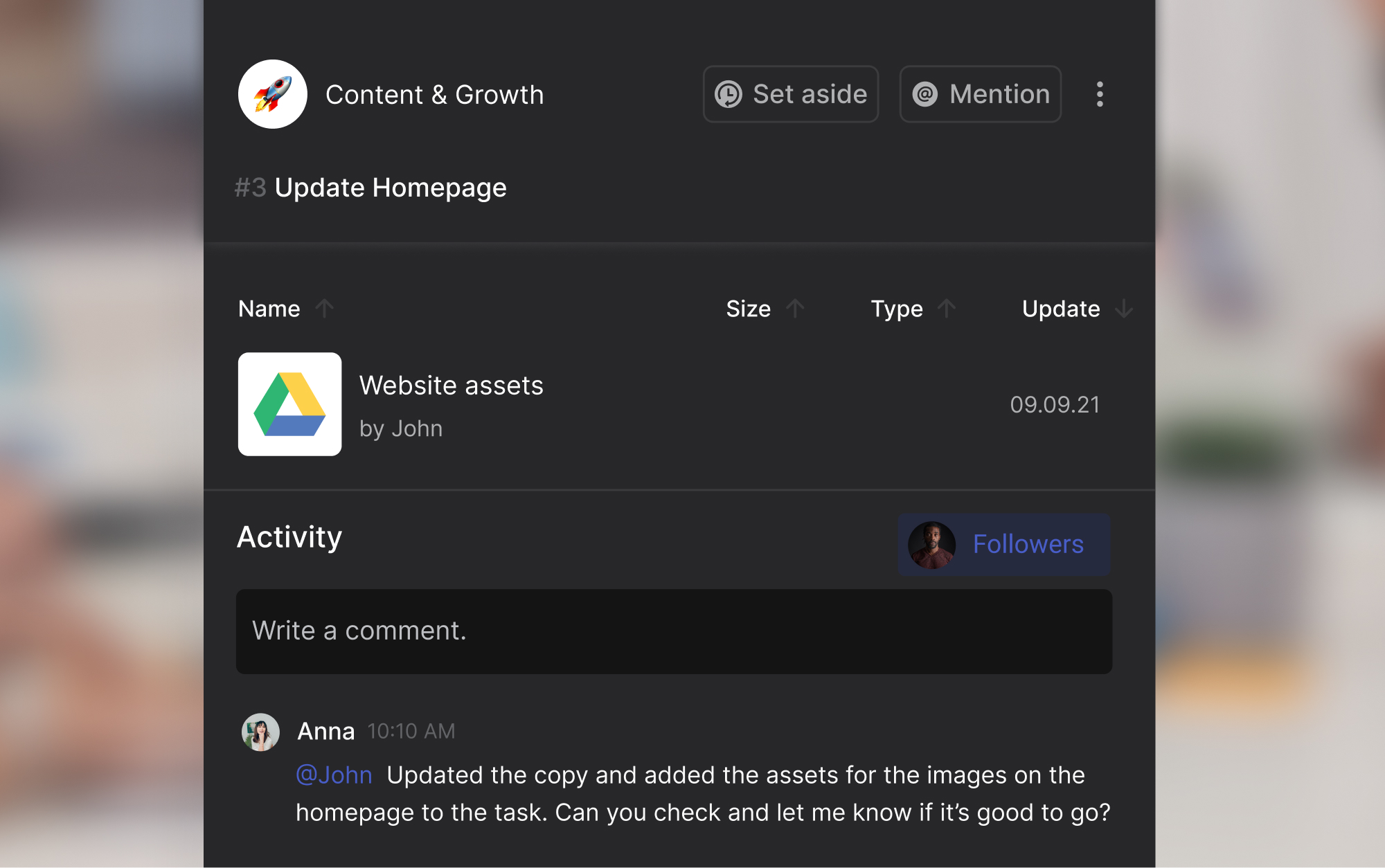
HBR research on client retention makes the economics plain: a 5 percent lift in retention can raise profits by 25 to 95 percent. Retention starts in week one, not month twelve. The client brief is the first moment a new team member could fall out of alignment with the client's expectations. Get the brief right, pin it somewhere every team member sees, and the rest of the engagement compounds from there.
For the broader cluster reading, see our client onboarding questionnaire (upstream input), client working agreement (operational rules), account manager skills (who inherits the brief once it is written), and freelance client management (solo-operator version, with a working example in our Fosca case study).
A good brief compounds every week of the engagement. For the solo-operator version in practice, see how freelancers run client work on Rock. Rock combines chat, tasks, and notes in one workspace so the brief, the work, and the conversations all live together. One flat price, clients join free. Get started for free.