When to Stop Using WhatsApp for Your Agency (and What to Use Instead)
WhatsApp works. That is the problem.
It is free, it is on everyone's phone, and it gets the job done just enough that agencies never switch. Quick messages to the client, voice notes to the team, a PDF shared in the group chat. For a 3-person agency with 1 client, that is fine.
But at some point, your team grows. You take on more clients. Projects overlap. And the tool that "works" starts quietly costing you hours, decisions, and trust.
This article is for agency teams that run client work on WhatsApp group chats. Not the WhatsApp Business API or CRM use case. If you use WhatsApp for customer support at scale, this is not for you. If you use it as your team's main workspace, keep reading.
"Our people were burned out. They couldn't focus on their work. Their phones constantly were pinging with work-related messages at all hours of the day, and they felt like they couldn't switch off." - Alka Gupta, Director of Data, Marketing, Business Operations and People at BukuWarung, in a Slack case study
WhatsApp Is Not the Problem. The Scale Is.
Let's be clear about something: WhatsApp is not a bad tool. In many parts of the world, it is the default infrastructure for business communication. 97% of people in Kenya use WhatsApp. In Brazil, it is 98%. In Indonesia, 87%. These are not careless choices. When everyone already has WhatsApp, using it for work makes practical sense.
The inflection point comes around 5-10 team members or 3+ active client projects. That is when unstructured group chats stop scaling. You go from "quick and easy" to "I can't find anything, decisions are lost, and my phone never stops buzzing."
If your agency is under 5 people with 1-2 clients, WhatsApp is probably fine. Keep using it. The rest of this article is for the agency that has grown past that point and feels the friction daily.
7 Signs WhatsApp Has Outgrown Your Agency
These are not theoretical problems. They are patterns we see in agencies across Southeast Asia, Africa, and Latin America. If you recognize three or more, it is time to look at alternatives.
1. You Can't Find the Brief a Client Sent Last Week
WhatsApp has no file organization. Everything sits in a flat chat scroll. Search works for text, but finding "that PDF the client sent on Tuesday" means scrolling through hundreds of messages or digging through your phone's media folder.
When you have 5+ active client projects and each one generates briefs, assets, feedback docs, and revisions, the flat scroll becomes a real problem. Files are not organized by project. They are organized by time, which means everything is mixed together.
2. Decisions Are Getting Lost in Group Chats
Someone asks a question. Three people reply. The answer is somewhere in 47 messages. Nobody pinned it. Next week, someone asks the same question again. This is the most common failure mode for teams on WhatsApp.
WhatsApp has no message threading. No way to organize a discussion by topic. No way to mark a message as a decision. Everything happens in one flat timeline, and anything older than a day effectively disappears for practical purposes. For more on why this happens and how to fix it, see our article on remote communication mistakes.
3. You Have More Group Chats Than You Can Keep Track Of
"Client A - General", "Client A - Design", "Client A - Urgent", "Client A - Old (do not use)." Sound familiar? When your only organizational unit is "group chat," you end up creating dozens of them. Each one is a separate silo with its own conversation history, its own files, and its own lost decisions.
WhatsApp does not have channels, topics, or any organizational layer above the group chat. WhatsApp Communities (launched in 2025) help somewhat by grouping related chats, but they still lack threading, search across groups, and task management.
4. Clients Message at Midnight and Someone Feels Obligated to Reply
WhatsApp has no business hours setting. No "set aside for later." The blue read receipts create social pressure to respond immediately, even at midnight. Because WhatsApp is also your personal messaging app, work messages arrive alongside family conversations and friend group chats. There is no separation.
This is not just uncomfortable. Research published in PMC found that WhatsApp use for work-related communication is linked to measurable increases in employee burnout and stress. A separate study of healthcare professionals in Saudi Arabia showed the same pattern: work-related WhatsApp messages correlated with higher levels of depression, anxiety, and stress.
BukuWarung, an Indonesian fintech platform serving over 8 million small businesses, switched away from WhatsApp specifically because of this. After migrating, they saved over 250 hours in nine months and reported that their team could finally focus without the constant pinging.
For a framework on setting clear response time expectations with clients, see the P1/P2/P3 urgency framework in our virtual communication practices guide.
5. You're Copying Messages Between WhatsApp and Your Task Tool
Someone discusses a task in WhatsApp. Then someone manually creates it in Trello, Asana, or Google Sheets. Double work. And the task is now disconnected from the conversation that created it. When the client asks "why did we decide to do it this way?", the answer is buried in a WhatsApp thread that nobody can find.
This is a sign that your communication and task management need to live in the same place.
6. New Team Members Can't Catch Up on Project Context
A new hire joins your agency. They need to understand where each client project stands. On WhatsApp, that means scrolling through months of group chat history, if they even have access to it. WhatsApp ties message history to individual devices. If you reinstall the app or switch phones without a backup, the history is gone.
There is no centralized, searchable project history. No notes. No documented decisions. Just a chat log that goes back as far as your phone's backup allows.
7. You've Sent a Message to the Wrong Group
Internal pricing shared in a client chat. A complaint about a client sent to the client's own group. An off-topic message in the wrong project chat. When you have 15+ WhatsApp groups and no permissions system, this will happen.
The deeper risk: confidential client information can be shared accidentally in large groups. A group invite link gets forwarded and suddenly the wrong people have access. There is no audit trail, no compliance logging, and no way to control who sees what.
For agencies working with European clients, there is a GDPR concern too. Using WhatsApp for professional communication is rarely GDPR-compliant because of metadata sharing with Meta and the lack of data processing agreements.
What About WhatsApp Communities?
WhatsApp launched Communities in 2025. It lets you organize up to 50 sub-groups under one umbrella, with a shared announcement channel. For agencies drowning in group chats, this is a genuine improvement.
But Communities organize groups. They do not turn WhatsApp into a workspace. You still do not get:
- Message threading within a group
- Search across all groups in the community
- Task management or project boards
- Role-based permissions beyond basic admin controls
- Integration with other work tools
- Compliance, archiving, or audit trails
If your only problem is "too many group chats," Communities might be enough. If your problems include lost decisions, missing files, no task tracking, and work-life boundary issues, Communities do not solve those.
"The overhead charge of communication goes from 20% of people's time to 40%, 50%, 60%. At a big enough organization, you have people who are contributing almost nothing, but using up like a factor of 10x of other people's time." - Stewart Butterfield, Co-founder and CEO of Slack, at Axios HQ
What to Look for in a Replacement

Before picking a tool, know what you actually need. Not every agency needs the same thing. Here are the criteria that matter most for teams switching from WhatsApp:
Chat and tasks in one place. If you are currently copying messages from WhatsApp to a task tool, you need a platform where conversations and tasks coexist. When someone discusses a task, it should become a tracked task without manual copying.
Client access without per-user fees. Agencies add and remove clients constantly. Per-user pricing means every new client project costs more. Look for flat pricing or generous guest access.
File organization per project. Files should be organized by project, not by the order they were sent. Searchable, accessible, and not tied to someone's phone.
Async-friendly design. Business hours settings, message flagging for later, and no read receipt pressure. Your team should be able to respond when they are ready, not when the blue ticks appear.
Easy migration. You should not lose your conversation history. Look for tools that let you import from WhatsApp directly.
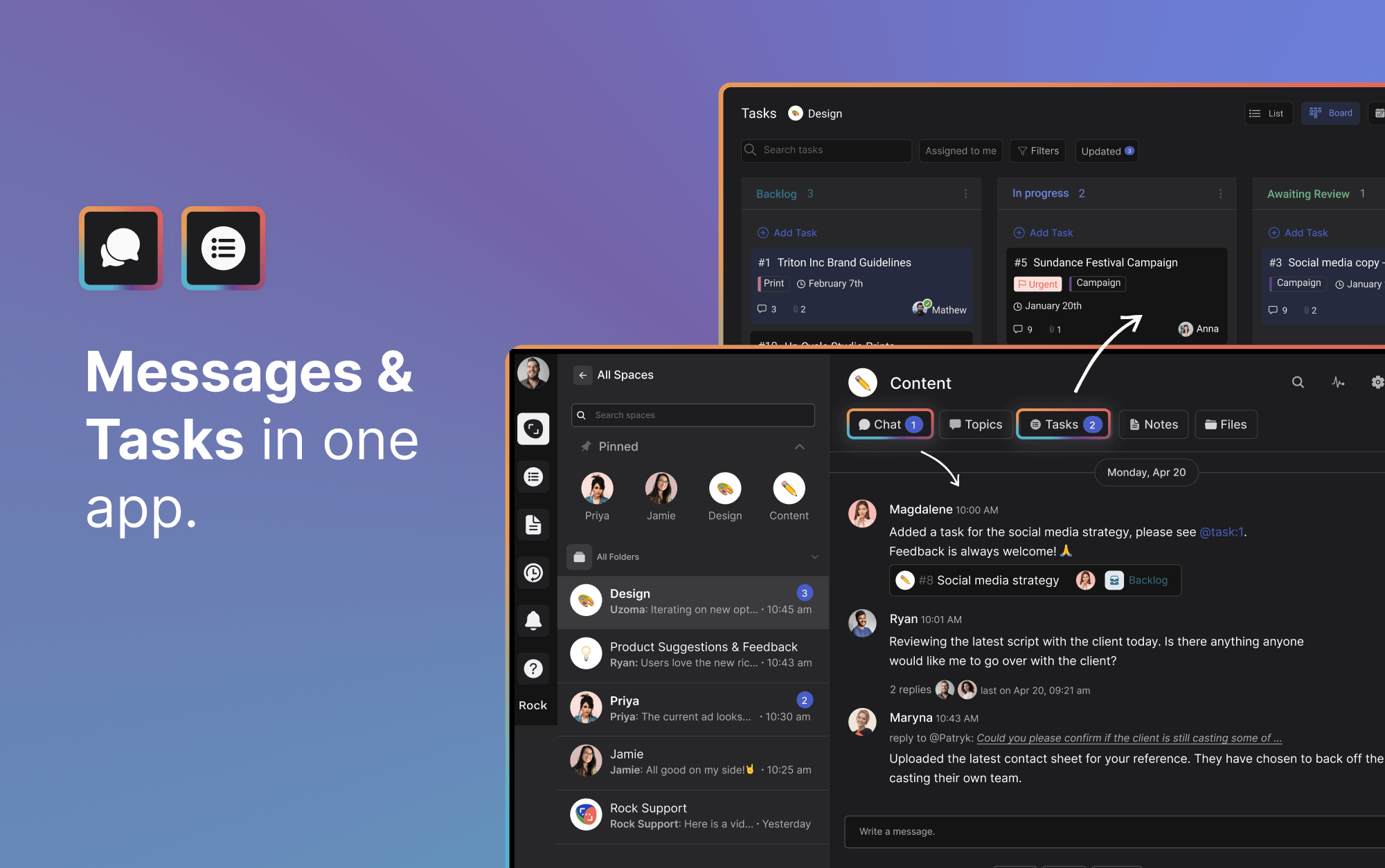
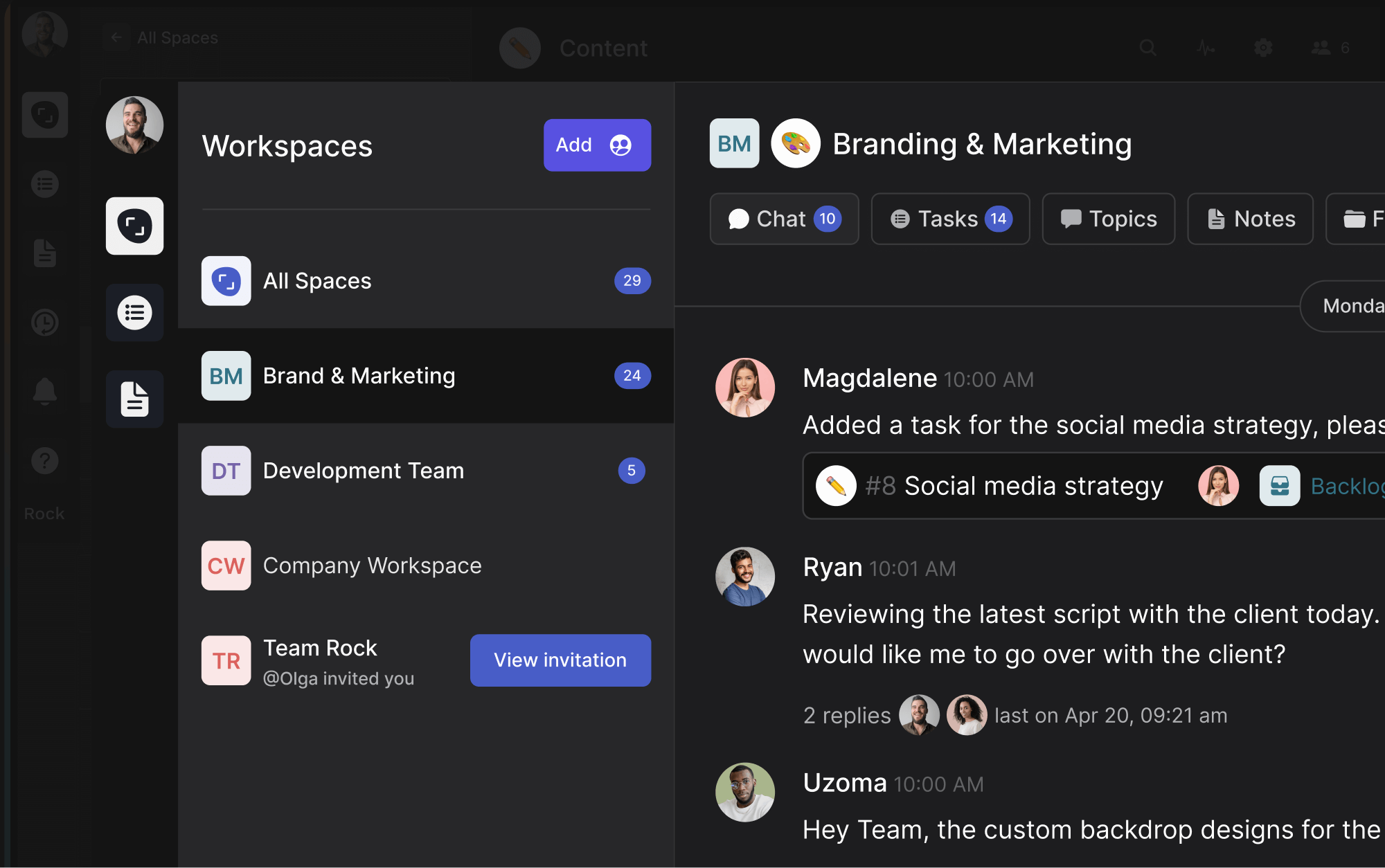
Rock fits these criteria. Chat, tasks, notes, and files in every project space. Clients join directly at no extra cost. One flat price for unlimited users. For the full list of messaging alternatives, see our comparison guide.
How to Migrate Without Losing Your History
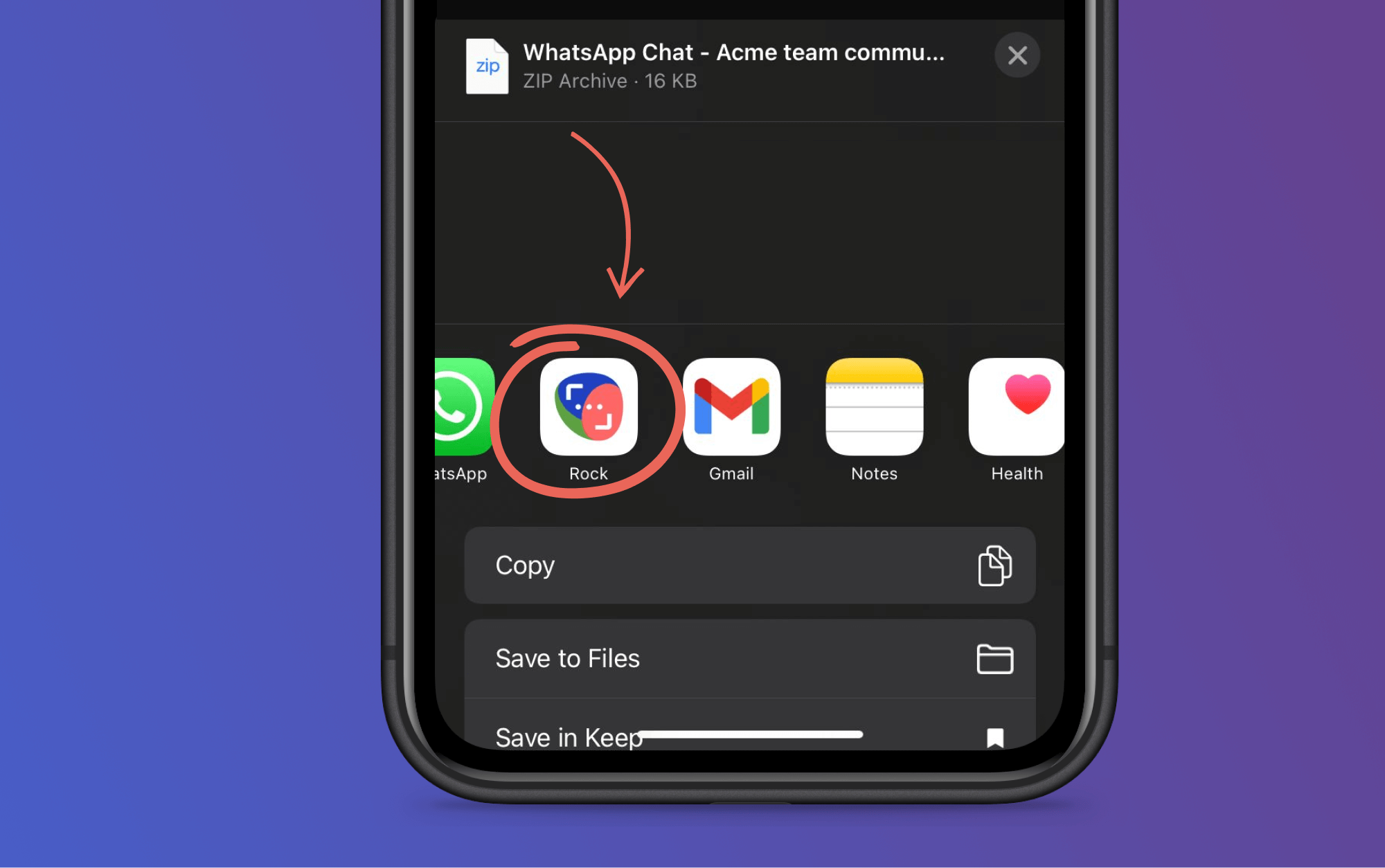
Rock has a WhatsApp import feature that brings your chat history into your new workspace. Export your chats from WhatsApp (Settings > Chats > Export Chat), then import them into the relevant Rock space. Your conversations, timestamps, and media come along.
For step-by-step instructions, see the Rock import guide.
One thing that makes the switch easier: you do not have to migrate everything at once. Start with one client project. Run it in Rock for a week while keeping WhatsApp for the rest. Once your team sees the difference, they will want to move the other projects too. Forcing a full switch on day one creates resistance. Letting people experience the improvement creates momentum.
Final Thoughts
WhatsApp got your agency to where it is. That is worth acknowledging. But the tool that works for 3 people and 1 client does not work for 15 people and 8 clients. The signs show up gradually: lost files, repeated questions, midnight messages, wrong-group mistakes. Each one is small. Together, they cost hours every week and erode client trust.
If you recognized three or more of the signs above, it is time to try something else. Not because WhatsApp is bad, but because your agency has outgrown it.
Moving off WhatsApp is not about sending fewer messages. It is about making the right information visible at the right time, so nobody has to scroll back through a chat to find it.
__________________________________________________
Ready to move your agency beyond WhatsApp group chats? Rock combines messaging, tasks, notes, and files in one workspace. Clients join directly. One flat price, unlimited users. Get started for free.