MoSCoW Method: How to Prioritize With Must, Should, Could, Won't
The MoSCoW method is a scoping framework, not a to-do list system. Used right, it forces a team to agree on what ships versus what waits. Used wrong, it becomes a 40-item list of "Must-haves" that guarantees nothing ships on time.
This guide covers what MoSCoW actually is, where it came from, a real worked example, how it compares to RICE and Eisenhower, and the honest failure modes nobody else writes about. The interactive quadrant builder below fills a matrix as you assign priorities, so you can see the shape of your decisions in real time.
Contents
What Is the MoSCoW Method?
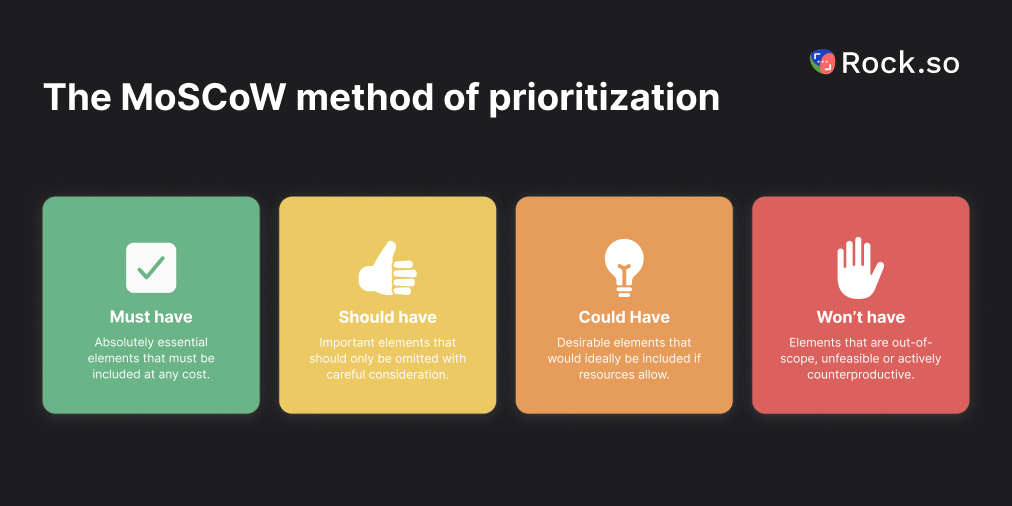
The MoSCoW method is a prioritization framework that sorts features or tasks into four categories by importance: Must-have, Should-have, Could-have, and Will-not-have (this time). The capital letters spell MoSCoW; the two lowercase "o" letters are there to make the acronym pronounceable. It is designed for scope decisions on a single release or project, not ongoing task management.
M, Must-have. Non-negotiable. The project fails without it.
S, Should-have. Important but not critical. Ship without if forced.
C, Could-have. Nice to have. Include if time and budget allow.
W, Will-not-have (this time). Explicitly out of scope for this release.
Build a MoSCoW matrix in 30 seconds
Click an item to edit it. Click M, S, C, or W to assign a category. Add or remove items to match your real list.
Nothing yet
Nothing yet
Nothing yet
Nothing yet
The Four Categories Explained
The four letters look simple. The discipline is in applying them honestly, not in memorizing the labels.
Must-have. If the feature is missing, the release is a failure. Most teams overuse this bucket because every stakeholder wants their request to be a Must. A healthy MoSCoW matrix has Must-haves under 60 percent of total items. If more than half are Must, the team has stopped prioritizing and started listing.
Should-have. Important but survivable. The release ships without it if the timeline slips. This is where most real priorities live once the ego leaves the room.
Could-have. Included only if everything in Must and Should is done with time to spare. These are often the first things cut when reality arrives, which is why practitioners argue they are already Will-not-haves in disguise (more on this in the failure modes section).
Will-not-have (this time). Explicitly out of scope. The "this time" suffix matters. It promises reconsideration in a later release without committing to it. Writing items into this bucket is as valuable as writing Must-haves, because it kills the "while we are at it" requests that expand scope in private.
Where MoSCoW Came From
The acronym was introduced by Dai Clegg in the early 1990s, first published in Case Method Fast-Track: A RAD Approach (Addison-Wesley, 1994). It was developed inside the Dynamic Systems Development Method (DSDM), one of the earliest agile software delivery frameworks, and later adopted by the Agile Business Consortium as the standard prioritization technique for DSDM projects.
"MoSCoW is a prioritisation technique for helping to understand and manage priorities. The use of the MoSCoW method works particularly well on projects. It also overcomes the problems associated with simpler prioritisation approaches." - Agile Business Consortium (DSDM handbook)
The DSDM handbook remains the canonical reference. Wikipedia's article on the MoSCoW method is a useful secondary source that tracks later additions like the Institute for Business Analysis (IIBA) adoption.
Worked Example: Pricing Page Launch
Here is how an agency team might apply MoSCoW to a pricing page relaunch scheduled for 4 weeks.
Raw feature list (14 items): new messaging, updated design, per-tier feature comparison, FAQ section, analytics tracking, legal approval of copy, customer quotes, A/B test setup, mobile responsive design, pricing calculator, chat widget for sales, localized pricing for EU, video demo embed, live chat integration.
Must-have (5 items): new messaging, updated design, per-tier feature comparison, analytics tracking, legal approval of copy. Without any of these, the page is not shippable. Every Must-have is a potential launch blocker if it slips.
Should-have (4 items): FAQ section, customer quotes, A/B test setup, mobile responsive design. Important. Team will fight hard to ship them, but the launch proceeds if one or two get deferred.
Could-have (3 items): pricing calculator, chat widget for sales, video demo embed. Visible only if the Must and Should work lands with time to spare. History says 1 of 3 ships on time; the rest slip to the next iteration.
Will-not-have this time (2 items): localized pricing for EU, live chat integration. Explicitly deferred. Named and off the backlog for this release. Both are legitimate asks, just not for this launch.
Total time spent on the exercise: 45 minutes. Output: a shared scope document the team and sponsor both signed off on. That sign-off is the real value of MoSCoW. It converts fuzzy "we want everything" pressure into a concrete, audit-able list.
"In almost every organization I have advised, I have encountered the same problem: far too many projects, and far too few that truly matter." - Antonio Nieto-Rodriguez, Harvard Business Review
MoSCoW vs RICE vs Eisenhower vs Kano
MoSCoW is one of several prioritization frameworks. Each has a different shape and serves a different decision. Picking the wrong one makes the prioritization feel harder than it needs to be.
| Framework | Best for | Time to apply | Output | Weakness |
|---|---|---|---|---|
| MoSCoW | Release scoping, stakeholder alignment | 30 min per release | 4 buckets of features | Everything ends up as Must-have |
| RICE | Product roadmap prioritization | 20 min per feature | Numeric score | Confidence inflation skews scores |
| Eisenhower | Daily task triage | 2 min per day | 4 quadrants by urgency and importance | Breaks when everything feels urgent |
| Kano | Customer satisfaction analysis | 60 min plus user survey | Attraction or dissatisfaction curves | Requires real user research to work |
Short version: MoSCoW is best when a stakeholder group needs to agree on scope for a specific release. RICE is better when you are ranking product features by expected value. Eisenhower is for daily task triage. Kano is for validating whether a feature actually drives user satisfaction. For broader situational strategic analysis (internal strengths and weaknesses, external opportunities and threats), reach for a SWOT analysis instead. For an internal-resource audit of which strengths actually produce sustained advantage, run a VRIO analysis. To convert either analysis into a set of named strategic moves, use our TOWS matrix guide, which needs real user research to apply.
For the broader decision on which framework fits your situation, see our how to prioritize tasks guide, which has a decision quiz that recommends one of seven frameworks based on your work context.
When MoSCoW Breaks
Three failure modes kill MoSCoW more often than any tool or technique problem. Each has a fix.
Failure 1: Everything becomes a Must-have. Stakeholders push hard for their asks, and without discipline, the Must bucket balloons to 12 of 14 items. At that point MoSCoW stops discriminating anything. The fix: cap Must-haves at 60 percent of total items by convention. If the team cannot get under the cap, the project scope is too big for the timeline and needs to be cut upstream, not prioritized downstream.
Failure 2: Could-haves are a graveyard. Items labeled Could-have almost never ship. They sit in a bucket that implies possibility but delivers nothing. Mike Cohn, founder of Mountain Goat Software, put this plainly:
"I can't recall a project ever including any could-have features. A feature on the could-have list might as well be put on the Will-Not-Have list." - Mike Cohn, Mountain Goat Software
The fix: treat Could-have as a stretch list, not a commitment. Communicate that to stakeholders at scoping time. "If we label this Could-have, it probably will not ship. Are you okay with that?" The honest conversation upfront saves the angry one later.
Failure 3: The Will-not-have list is missing or empty. Teams happily list Must, Should, and Could, then skip Will-not. The result is implicit scope creep, because anything unlisted becomes a candidate for addition mid-project. The fix: require a populated Will-not-have list with at least 2-3 explicit items. Naming what is out of scope is where MoSCoW earns its value.
How to Run a MoSCoW Workshop
A good MoSCoW session takes 45-60 minutes with 4-8 people. Anything more and you have too many cooks. Anything less and you are missing stakeholder perspective.
Prep (15 min before). Write the raw feature list. Include everything on the table, even obvious things. Distribute to attendees 24 hours before the session so people arrive with opinions already formed.
Agree on the cap (5 min). Before any prioritization, agree on the Must-have cap. Default is 60 percent of total items. Write it on the whiteboard. This is the single most important workshop move, and the one most teams skip.
Round 1 (Individual scoring) (10 min). Each person silently tags every item M, S, C, or W. No discussion. Silence prevents the loudest voice from anchoring the group.
Round 2 (Disagreements) (20 min). Review items where the team disagrees. Typically 20-30 percent of items. Each disagreement gets a 1-minute debate, then a group vote. If a vote is 50/50, the item goes to the more conservative bucket (if Must/Should, pick Should; if Should/Could, pick Could).
Round 3 (Sanity check) (10 min). Look at the final Must-have list. Over cap? Cut the weakest Must down to Should. Under cap but Should is huge? That is fine. Confirm the Will-not-have list has at least 2-3 explicit items.
Output (5 min). Document the final matrix in a shared doc or task tool. Name the sponsor who owns the decision. Circulate within 24 hours. Lock the scope. If new asks come in mid-project, they either displace an existing item or wait for the next release.
What we do at Rock. We run MoSCoW scoping for every major release with the product and design teams. The scope doc lives as a pinned note in the project space alongside the task board. When a new "while we are at it" request lands in chat, the response is "does this displace a Must or wait for next release?" That single rule cuts about 80 percent of scope creep before it starts.
Frequently Asked Questions
What does MoSCoW stand for? Must-have, Should-have, Could-have, and Will-not-have (this time). The two lowercase "o" letters are there to make the acronym pronounceable; they have no meaning.
Who invented the MoSCoW method? Dai Clegg introduced the technique in the early 1990s and first published it in Case Method Fast-Track: A RAD Approach (1994). It was developed within the DSDM framework and is now maintained as a canonical technique by the Agile Business Consortium.
What is an example of MoSCoW prioritization? For a 4-week pricing page relaunch, the Must-haves might be new messaging, updated design, pricing table, analytics, and legal approval. Should-haves might be FAQ, customer quotes, and A/B testing. Could-haves might be pricing calculator and video demo. Will-not-haves might be EU localization and live chat. See the worked example section above for the full breakdown.
When should you use MoSCoW vs RICE? MoSCoW when a stakeholder group needs to agree on release scope (what ships, what waits). RICE when you are comparing product features by expected value (Reach × Impact × Confidence ÷ Effort), where the Effort input usually comes from a quick t-shirt sizing pass. MoSCoW is faster and more political; RICE is slower and more analytical. Use both for different decisions in the same project if needed.
What are the disadvantages of MoSCoW prioritization? Three main failure modes: (1) the Must-have bucket balloons to include everything, (2) Could-haves rarely ship in practice, (3) teams skip the Will-not-have list and lose the scope-setting benefit. All three are fixable with discipline. Cap Must-haves, treat Could-haves as a stretch list, require explicit Will-not-haves.
Need a place to run your MoSCoW workshops and turn the output into actual work? Rock combines chat, tasks, and notes in one workspace so the scope doc lives next to the tasks that deliver it. Get started for free.

Related Reading
More on prioritization and project scoping: how to prioritize tasks with 7 frameworks (the pillar guide with a decision quiz), the Eisenhower Matrix guide (for daily task triage), how to write a project plan (where MoSCoW fits into a plan), scope of work template, project vs task, and what is a project management framework.