Why 67% of Company Goals Fail (And What to Do Instead)
Why 67% of Company Goals Fail
Here is a stat that should bother you: 67% of well-formulated strategies fail because of poor execution. Not bad ideas. Not a lack of talent. Just a gap between what gets planned and what gets done.
The same research shows companies lose roughly 40% of their strategy's potential value during execution. That is real revenue left on the table every quarter.
The pattern looks familiar. Leadership sets ambitious company goals in a strategy meeting. Those goals land in a slide deck or a shared doc. Meanwhile, the team's actual work lives in a task board, a spreadsheet, or a group chat. The two never connect. After a few weeks, daily work takes over. The goals collect dust until next quarter's review.

This article breaks down why that happens and what you can actually do about it. We will cover goal-setting frameworks (OKRs, KPIs, SMART), but more importantly, we will cover the execution side that most guides skip entirely.
Which goal framework fits your team?
Answer 5 questions to get a personalized recommendation.
Why Company Goals Fail: Three Root Causes
Before picking a framework, it helps to understand why goals fail in the first place. It usually comes down to three problems.
1. The Clarity Crisis
According to Gallup's research, only 47% of employees clearly know what is expected of them at work. That number dropped 10 points since 2020. Think about that: more than half your team may not understand what they should focus on.
The same research found that workers whose managers help them set performance goals are 8 times more likely to be engaged. Clear goals are not just a planning exercise. They directly affect whether people care about their work.
For agencies, this hits hard. When you have multiple clients, shifting deadlines, and team members juggling projects, unclear goals mean people default to whatever feels most urgent. Strategic work gets pushed to "next week" forever.

2. The Alignment Gap
McKinsey's research shows that aligned teams see a 25% increase in performance. But alignment does not happen by accident.
In most organizations, departments set goals independently. Marketing writes their targets. Development writes theirs. Operations does the same. Nobody checks whether these goals actually support the same outcome. The result is teams working hard in different directions.
"Silos, and the turf wars they enable, devastate organizations. They waste resources, kill productivity, and jeopardize the achievement of goals." - Patrick Lencioni, Founder, The Table Group
For agencies with 10 to 50 people, this shows up when client teams operate as islands. One team over-delivers on a low-margin account while the team handling your biggest client is stretched thin. Without aligned goals, effort does not match priority.
Cross-functional collaboration becomes critical once you pass the 10-person mark. The fix is not more meetings. It is making sure every team can see how their goals connect to what other teams are doing. Visibility solves most alignment problems before they become turf wars.
3. The Whirlwind
This is the one nobody talks about enough. Chris McChesney calls it "the whirlwind," the mass of urgent daily work that keeps the lights on but drowns out anything strategic.
"The real enemy of execution is your day job! We call it the whirlwind. If you and your team operate solely from within the whirlwind, you won't progress. All your energy is spent just trying to stay upright in the wind." - Chris McChesney, Co-author of The 4 Disciplines of Execution, FranklinCovey
Client emails, bug fixes, scope changes, and status updates all demand attention right now. Strategic goals that are important but not urgent keep getting bumped. This is why the Eisenhower matrix exists: to separate what is truly important from what just feels urgent. The multitasking myth makes it worse. People think they can juggle strategic goals alongside daily work, but research says otherwise.
Choosing the Right Goal-Setting Framework
There is no single best framework. The right one depends on your team size, your biggest challenge, and how you work. Here is an honest breakdown of when each one works, and when it does not.
OKRs (Objectives and Key Results)
Best for: Strategic alignment across teams of 20 or more people. Quarterly cadence. Research shows 83% of companies using OKRs report benefits, and roughly 45% of Fortune 500 companies have adopted them.
How they work: You set 3 to 4 ambitious objectives (qualitative) and attach 2 to 5 measurable key results to each. Teams create their own OKRs that ladder up to company-level objectives. This creates visible alignment from top to bottom.
Skip this if: You have fewer than 15 people (the overhead is not worth it), you try to track routine operations with OKRs (they are for strategic bets, not daily work), or you end up with more than 5 objectives per team. Too many OKRs means no real priorities.

"An effective goal-setting system starts with disciplined thinking at the top, with leaders who invest the time and energy to choose what counts. If we try to focus on everything, we focus on nothing." - John Doerr, Chairman, Kleiner Perkins
KPIs (Key Performance Indicators)
Best for: Monitoring the health of your business. KPIs are not goals themselves. They are the dashboard lights that tell you whether things are going well or badly.
How they work: You pick a handful of metrics that represent the health of your operation. Revenue, client satisfaction, utilization rate, response time. You track them consistently and investigate when they move in the wrong direction.
Skip this if: You treat KPIs as goals. This is a common mistake that leads to metric gaming. When "increase NPS to 80" becomes the goal instead of "deliver better client experiences," people find shortcuts that hit the number without improving the thing it is supposed to measure. KPIs tell you where to look. Goals tell you where to go. You need both.
SMART Goals
Best for: Individual tasks, project scoping, and deliverable-based work. The SMART framework (Specific, Measurable, Achievable, Relevant, Time-bound) is simple, direct, and works for things with a clear finish line.
How they work: Instead of "improve our social media," you write "publish 12 client case studies on LinkedIn by June 30." Specific, measurable, achievable, relevant, time-bound. Done. Everyone knows what success looks like, and there is no room for interpretation.
Skip this if: You rely on SMART for everything. The "Achievable" part can create artificial ceilings on ambition. If Google had set "achievable" goals in 2004, they would not have built Gmail with 1GB of storage when competitors offered 2MB. SMART is great for scoping deliverables. It is less useful for setting direction.
For Agencies Specifically
Most agencies benefit from a mixed approach. Use SMART goals and KPIs for daily client work: utilization rates, project margins, delivery timelines. These keep the machine running.
Then set quarterly OKRs for growth: launching a new service line, improving client retention by a specific percentage, or entering a new market. This gives you the structure to work on the business while you work in it. Your organizational strategy should connect these two layers.
How to Actually Execute on Goals
Frameworks are just containers. Execution is where goals live or die. Here are five practices that separate teams who hit their company goals from teams who forget them by week three. None of these require a new tool or a certification. They just require discipline.
Connect Goals to Daily Work
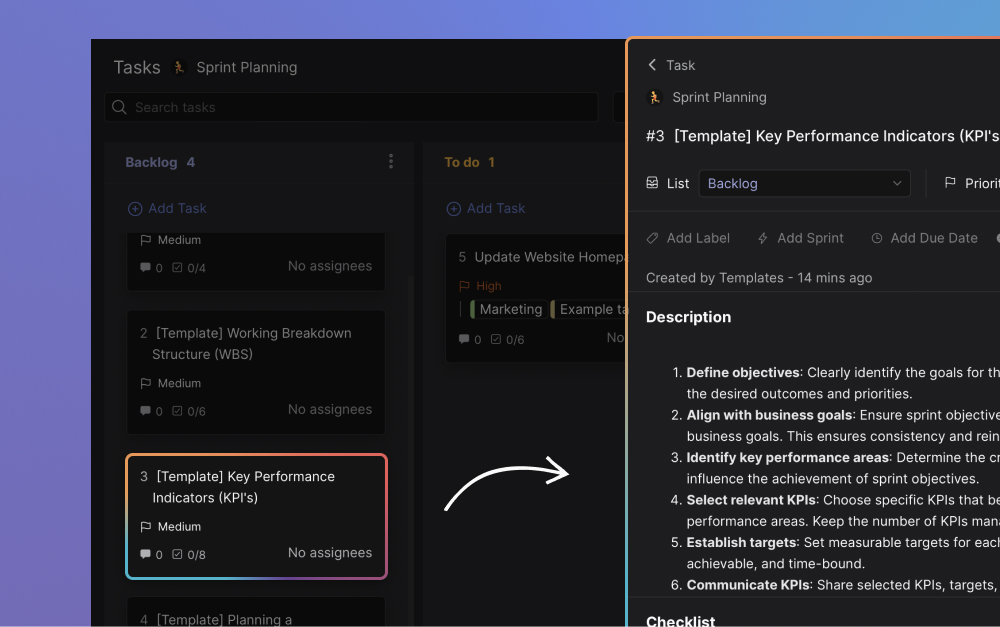
If your goals live in one place and your tasks live in another, the gap between them will grow every day. Your objectives need to show up where your team actually works. That means linking objectives to tasks on your board, not keeping them in a separate strategy document nobody opens.
When someone finishes a task, they should be able to see which goal it moves forward. When someone plans their week, they should know which of their tasks are goal-related and which are just keeping the lights on. Prioritizing tasks becomes much easier when you can see the goal behind each one.

Review Weekly, Not Quarterly
Goals that only get reviewed quarterly are already dead by week four. The cadence matters more than the framework. A 15-minute weekly check-in where you ask "are we on track?" catches problems early. A quarterly review just confirms what everyone already knew: the goals did not happen.
Keep it simple. Each goal owner shares a quick update: on track, at risk, or off track. If something is at risk, discuss it now, not in three months. This maps well to sprint cadences if your team already works in sprints.
One Owner, Not a Committee
Every goal needs a single person who is responsible for it. Not a team. Not a department. One name. Committees dilute accountability. When everyone is responsible, nobody is responsible.
The owner does not have to do all the work. They just need to be the person who tracks progress, flags risks, and makes sure the goal does not slip through the cracks. In practice, this often means the person closest to the work, not the most senior person in the room.
Document Decisions, Not Just Goals
Most teams document what they decided to pursue. Few document why they chose that target, what alternatives they considered, and what they said no to. This context matters when things change, and things always change.
When you revisit a goal mid-quarter and wonder whether to adjust it, having the original reasoning written down saves hours of debate. Good documentation practices apply to goals just as much as they apply to projects.
Kill Goals That Stopped Making Sense
Sunk cost fallacy applies to goals too. If the market shifted, a key client left, or you learned something that makes a goal irrelevant, drop it. Chasing a goal that no longer matters is worse than having no goal at all. It wastes energy and demoralizes the team.
This requires psychological safety. People need to feel comfortable saying "this goal does not make sense anymore" without it being seen as failure. Build that into your review process. One way to do this: add "should we kill any goals?" as a standing question in your weekly check-in.
Agency-Specific Goals That Actually Matter
Generic goal-setting advice often misses the metrics that matter for agencies. If you run a digital agency, here are the numbers worth tracking as part of your strategic objectives.
Utilization Rate: 70-85%
This is the percentage of your team's available hours spent on billable client work. Below 70%, you are leaving money on the table. Above 85%, your team is heading toward burnout with no room for internal projects, learning, or business development.
Track it weekly, not monthly. Monthly averages hide the weeks where your team was at 50% (bench time) or 95% (crisis mode). A healthy agency keeps this number visible at all times, not buried in a monthly finance report.
Project Gross Margin: 50-70%
Revenue minus direct costs (salaries, freelancers, tools) for each project. If your margins are below 50%, you are either underpricing or overdelivering. Both are fixable, but only if you are actively tracking the number.
Break this down by client. You will almost always find that your "biggest" client is not your most profitable one.
Client Retention: 90% or Higher
Retaining clients is dramatically cheaper than acquiring new ones. Research consistently shows that even a 5% improvement in retention can increase profits by up to 75%. For agencies, a retained client means predictable revenue, lower sales costs, and deeper relationships that lead to bigger projects.
If your retention drops below 90%, investigate. Are you losing clients to competitors, to in-housing, or to dissatisfaction? Each cause needs a different fix. Dissatisfaction is a delivery problem. In-housing is a positioning problem. Losing to competitors is a value problem. Knowing which one you face changes your entire response.
Revenue Per Employee
This is the real growth metric when you are capacity-constrained, which most agencies are. Growing revenue by hiring more people is linear. Growing revenue per employee means you are getting better at what you do: better processes, better pricing, better project selection.
Track this quarterly. If it is flat while headcount grows, you are scaling without improving, and that catches up to you eventually.
A Note on Vanity Metrics
Social media followers, website traffic, and "number of proposals sent" feel productive to track, but they rarely connect to revenue. If a metric does not eventually lead to a billing event or a retained client, question whether it deserves a spot on your dashboard. Focus your goals on outcomes, not activity.
What We Recommend at Rock
The biggest reason goals fail is the disconnect between where they are written and where work happens. Your strategy lives in a doc. Your tasks live in a board. Your conversations live in a chat app. And none of these tools talk to each other.
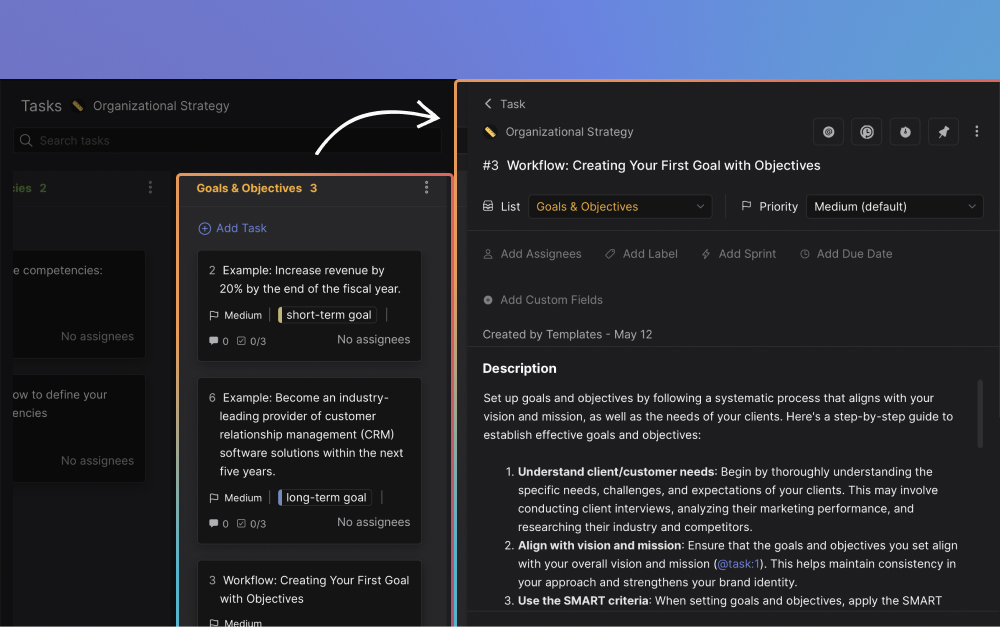
At Rock, we built the workspace around this problem. Your goal document lives in Notes, right next to the task board where the actual work happens. Weekly check-ins happen in the same space through chat. When someone updates a task, the progress is visible to anyone checking on the goal.
This is not about having more features. It is about having fewer places to look. When strategy and execution live in one workspace, the gap between "what we planned" and "what we did" gets smaller every week.
For agencies specifically, this means each client project can have its own goals, tasks, and conversations in a single topic. No more switching between four apps to figure out whether a project is on track. If you are looking for task management apps that keep everything together, that is exactly what Rock is designed for.
Asynchronous work becomes easier too. When your team is spread across time zones, having goals, tasks, and updates in one place means nobody has to wait for a meeting to know what is happening. Updates are visible the moment they are posted, regardless of who is online.
The bottom line: the problem with most company goals is not the goal itself. It is the distance between where you write them and where you do the work. Close that gap, and execution follows.