Kanban vs Scrum: When to Use Each (and When to Blend)
You picked Scrum. It half-worked. Then you tried Kanban, and that worked better for some projects but not others. That is the normal experience for most teams running both project work and ongoing commitments. Both frameworks come from the same Agile roots, but they solve different problems, and picking the wrong one creates the classic agency mess: meetings that do not help, boards nobody updates, and sprints that end with nothing shipped.
This Kanban vs Scrum guide compares the two frameworks side by side, with the practical context most comparison articles skip. If you run client work or manage multiple projects at once, the decisions below will feel especially familiar. You will not get "here is what Kanban is" from scratch (our deep-dive guides cover that). You will get the decision framework: when to use each, how they fail, and why most agencies end up running a deliberate blend called Scrumban.
There is a comparison table below for the scan-readers, a three-question decision quiz for when you want a direct answer, and sections for when each framework wins. Pick the one that matches your work.

The 30-Second Answer
Scrum works best for fixed-scope projects with a clear end date. Think website builds, brand launches, campaign rollouts, product releases. The sprint cadence creates rhythm. The sprint review creates a client checkpoint. The sprint goal keeps the team focused.
Kanban works best for continuous flow. Retainers, support work, marketing ops, anything where requests arrive unpredictably and the team pulls work as capacity opens. There is no sprint boundary because there is no "end" to the work.
Most agencies run both. Scrumban (or parallel Scrum plus Kanban boards) is the honest default: Scrum on fixed-scope projects, Kanban on retainers, one team moving between disciplines based on the work type. If you are wondering which to start with, pick the one that matches more than half your current work.
Compare Scrum and Kanban at a Glance
The table below lays out the seven dimensions that actually change how the framework feels day to day. Scan this first. Detailed sections follow.
| Dimension | Scrum | Kanban |
|---|---|---|
| Planning cadence | Plans once per sprint. The team picks what fits the sprint goal and commits. Between sprints, the plan does not change. That predictability is the point. | No fixed planning window. Work enters the backlog as it arrives. The team pulls new cards when WIP limits open. Replanning happens continuously, not on a schedule. |
| Roles | Three named roles: Product Owner (owns the backlog), Scrum Master (facilitates, removes blockers), Developers (deliver). At agencies, the Product Owner is usually the account manager. | No prescribed roles. Someone owns the board. Someone facilitates. Someone pulls. All three can be the same person. Accountability comes from the board, not from titles. |
| Change tolerance | Tolerates change between sprints but resists change mid-sprint. A new request on sprint day four gets the answer "we'll pick this up next sprint." That rule is the whole point of the sprint commitment. | Tolerates change anytime. New requests enter the backlog, get prioritized, and move into In Progress when capacity opens. No commitment window, so nothing to defend. |
| Team structure | Works best with a dedicated team of 3 to 9 focused on one backlog. Five sprints across five clients means five plannings, five standups, five reviews. Overhead scales linearly. | Indifferent to team structure. One person can run a board, so can fifteen. People shared across clients appear on multiple boards with no ceremony tax. |
| Client involvement | Sprint review every two weeks is a formal checkpoint. Client sees output, signs off, feedback shapes next sprint. Structured client engagement that works well when the client shows up. | No formal review. Clients see the board anytime. Feedback arrives as card comments. Lower friction when clients prefer a live feed over scheduled checkpoints. |
| Ceremony overhead | Planning, daily standup, review, retro. Roughly 4 to 6 hours per person per 2-week sprint. Across five clients, that is a full day per week per person in ceremonies alone. | A 10-minute board check daily and a monthly 30-minute retro. Under an hour per week. That margin goes directly into billable work. |
| Best fit | Fixed-scope projects, hard launch dates, clients who review weekly, teams focused on one project. Brand launches, website builds, campaign rollouts. | Retainers, ongoing support, unpredictable requests, async teams across time zones, people shared across multiple clients at once. |
"With a loaded backlog, no planning meetings are necessary. There are no milestones, no sprints, and no retrospectives. Kanban flows continuously, so long as there is work to do." - Eric Brechner, Agile Project Management with Kanban
Brechner is deliberately sharp there. Pure Kanban can skip all the Scrum ceremonies. Most teams still keep a monthly retro because reflection is useful, but the planning meeting is genuinely gone.
When Scrum Wins
Scrum is the right pick when the work has a defined endpoint and the team benefits from a forcing function. Specifically:
Fixed-scope projects. Website rebuilds, brand launches, product releases, campaign rollouts. The scope is signed, the deliverable is clear, the client paid for a specific outcome. Sprints create momentum. The sprint review is the natural moment for formal sign-off on each increment.
Hard launch dates. If the work has to be live by a date (event, season, contract), the sprint commitment model is useful. Each sprint ends with shippable increments, so if the timeline gets tight, you can show progress and negotiate scope instead of slipping everything.
Client who engages weekly. Scrum's sprint review is a two-week promise: you show working output, the client reacts, you adjust. Clients who enjoy this cadence get more value from Scrum than from a Kanban board they are supposed to check themselves.
Team focused on one project. A dedicated team of 3 to 9 running Scrum ceremonies is the textbook Scrum setup, and it genuinely works. The more your team looks like this, the more Scrum pays off.
"Scrum is very effective for certain types of problems. Scrum works best for a backlog of mixed work item types with no consistent workflow." - Corey Ladas, Scrumban: Essays on Kanban Systems for Lean Software Development
That second sentence is underappreciated. Scrum shines when the work is heterogeneous and does not have a natural flow. A brand launch has design, copy, dev, and QA mixed together. Scrum structures that chaos into a sprint goal. For the full setup, see our Scrum for agencies guide.
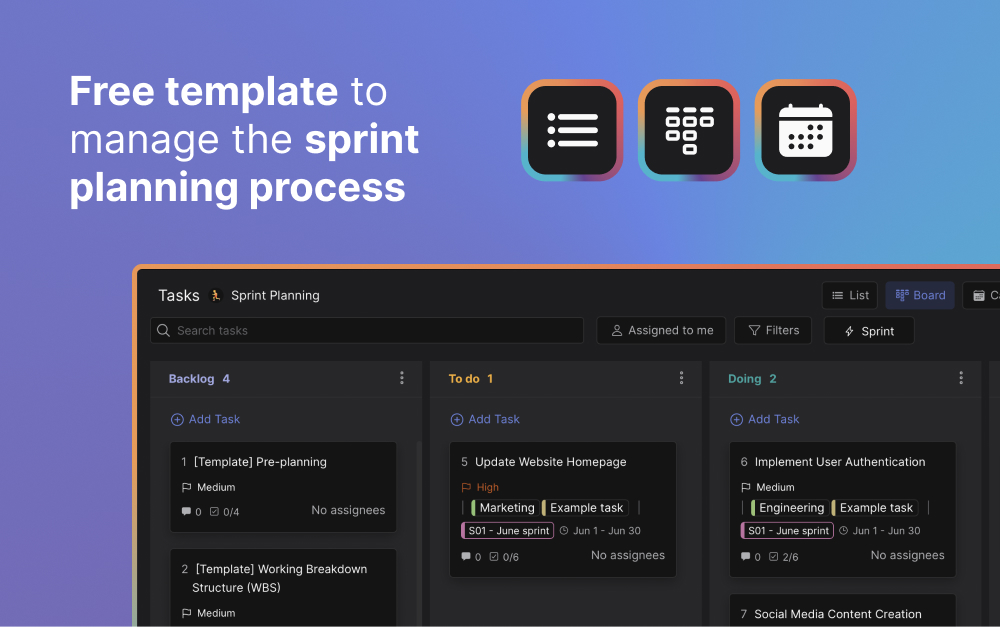
Free resource: our agile sprint planning template gives you a ready-to-run board with sprints, labels, and a sample backlog.
When Kanban Wins
Kanban is the right pick when the work is continuous, the requests are unpredictable, or the team is stretched across multiple contexts.
Retainers. Monthly retainer work (ongoing SEO, social content, small design requests) has no "sprint" and no natural end. Kanban is built for this. The backlog refills from client requests, the team pulls as capacity opens, WIP limits prevent overload.
Support and ops. Ticket-based work, bug fixes, incident response. Scrum's two-week commitment breaks the moment an emergency lands. Kanban treats new urgent work as a normal pull, often via an expedite lane that does not count against WIP limits.
Distributed, cross-timezone teams. Scrum's daily standup assumes everyone is roughly in the same few time zones. For teams spread across SEA, Latam, Europe, and North America, live daily standups are painful. Kanban boards are async-native: work is visible without a meeting.
Multi-client flow. One designer on five clients does not benefit from five sprint plannings. A Kanban board per client, pulled through when capacity opens, scales without ceremony tax.
The principle underneath this is older than Kanban as a software method. David J. Anderson's framing of the Kanban Method captures it:
"The Kanban Method does not ask you to change your process. It is based on the concept that you evolve your current process." - David J. Anderson, Kanban: Successful Evolutionary Change for Your Technology Business
That matters for agencies adopting project management for the first time. Kanban meets your team where they are. Scrum asks for structural change up front. For continuous-flow work, the lower adoption cost wins. For a full Kanban setup, see our Kanban methodology guide.

Which Fits Your Team? Pick in 3 Questions
If you want a direct answer rather than the reasoning, the quiz below points you to Scrum, Kanban, or Scrumban based on how you work.
Scrum or Kanban for your team?
Three questions. One recommendation.
1. How is your work organized?
2. How available is your client?
3. What does your team look like?
Scrumban: The Hybrid Most Agencies Actually Run
Scrumban was coined by Corey Ladas in 2008 to describe teams transitioning from Scrum to Kanban. Over time it became a destination, not a pathway. The most common agency setup we see looks something like this:
Sprint cadence, Kanban flow. Keep the 2-week rhythm of Scrum (planning on Monday, retro on the following Friday) but run the work inside the sprint on a WIP-limited Kanban board. You get the cadence benefits without the rigid sprint commitment.
Parallel boards. Fixed-scope projects run on a Scrum board with sprints. Retainers run on a separate Kanban board. Same team, same workspace, different disciplines per project type. This is the cleanest split when you have both types of work.
Kanban with quarterly planning. Run pure Kanban day to day, but hold a quarterly planning moment to set bigger goals and align on priorities. Useful when the work is mostly continuous but there is a need for occasional strategic checkpoints.
The risk with any hybrid is losing the discipline that made each framework work in the first place. If you take Scrum's ceremonies but ignore Kanban's WIP limits, you end up with meetings and overloaded boards. Pick the elements that solve your actual problem, not the ones that sound most impressive on a proposal.
Common Mistakes Picking Between Them
Five patterns show up repeatedly when agencies pick a framework.
Forcing Scrum on retainer work. Scrum's sprint commitment clashes with retainers where client requests arrive weekly. You end up either defending the sprint goal against legitimate urgent requests or breaking the sprint every week. Kanban fits this work.
Forcing Kanban on fixed-scope projects with hard deadlines. Kanban tracks flow well but does not naturally produce milestone-based deliverables. If the project has to be done by Tuesday, you need the sprint goal and review structure Scrum provides.
Running full Scrum across five clients with a shared team. Ceremony overhead scales linearly with client count. Five sprints means five plannings, five standups, five reviews. A 5-person agency running full Scrum on five clients spends a full day per week per person in ceremonies.
Ignoring WIP limits in Kanban. Kanban without WIP limits is just a board. The limit is the discipline. Without it, work piles up in the middle columns and cycle time explodes. If you are not enforcing a WIP limit somehow (software-enforced or social contract), you are not running Kanban.
Picking once and never revisiting. Your work changes. You pick up a new fixed-scope client or drop a retainer, and the balance shifts. Review the framework choice every quarter. If you started with Scrum and are now running a lot of support work, the Kanban piece of Scrumban probably fits better.
Running Either in Rock
Rock's Tasks mini-app ships with the views both frameworks need. The Board view is a native Kanban board: drag cards between columns, set labels, assign one or multiple team members with per-person status (none, in progress, blocked, completed). Write the WIP limit into the column name (for example "In Progress (3)") and the team enforces it socially.
For Scrum, the Unlimited plan adds native Sprints: group tasks into weekly, biweekly, or monthly cycles, filter the board by sprint, and run a clean sprint review. The agile sprint planning template gives you a starting setup.
For Scrumban or parallel boards, you can run both in one space: a Kanban view for the continuous flow and a Sprint filter for the fixed-scope work. Tasks and chat live together, so the conversation about the work sits next to the work itself.
What we do at Rock. We run Scrumban internally. One space per project, a Kanban board for flow, a weekly sprint cadence for planning, and Topics (our threaded chat feature) for async standups across time zones. Monthly retrospectives live in a shared note. The board is the source of truth. If it is not on the board, it does not exist. For teams under 20 people, this works without much ceremony overhead.
Final Thoughts
Most of the online debate about Scrum vs Kanban treats it as a purity contest. The real answer for agencies is less interesting: pick the framework that matches your work, run it for two weeks without changes, and adjust based on what the board actually shows you.
Scrum for fixed-scope with engaged clients. Kanban for retainers and flow. Scrumban when you have both, which is most of the time. For how these fit into the broader picture, see our project management framework guide. For the Agile roots both frameworks share, see our Agile for agencies guide.
Run Scrum, Kanban, or Scrumban in one workspace. Rock combines chat, tasks, and notes in one workspace. One flat price, unlimited users. Get started for free.