Asana vs Basecamp: Which One Fits Your Team in 2026?
Asana and Basecamp solve project work in opposite directions. Asana is structured project management. Tasks roll up into projects, projects into portfolios, portfolios into goals, with timelines, dependencies, and AI baked in from day one. Basecamp is calm finished-product PM. To-dos, schedules, message boards, Hill Charts, and Campfire chat all live in one workspace, the opinions are baked in, and you adjust your team to the tool.
That single difference shapes everything else. This Asana vs Basecamp guide compares them honestly, axis by axis, and runs the real cost at 5, 15, 30, and 50 seats using 2026 list prices. Some teams should pick Asana. Some should pick Basecamp. And some should pick neither because the chat-first workspace closer to how an agency team actually communicates lives somewhere else. Run the recommender below for a starting point.
Asana or Basecamp? Or neither?
Answer 4 questions for an honest pick.
1. What does your team need most?
2. How important is AI in the tool?
3. How many people will use it?
4. Do clients or freelancers need access?
Start over
Quick answer. Asana is structured project management with timelines, dependencies, and AI features baked in. Basecamp is calm async PM with built-in messaging and a flat-rate option that wins on cost at scale. Pick Asana if you run formal projects with reporting and want native AI. Pick Basecamp if you want simple, opinionated PM with chat included and predictable pricing. Pick neither if you want chat-first agency work with clients and freelancers in the same space.

Want chat in the same workspace?
Rock pairs messaging with tasks and notes. One flat price, unlimited users.
What Asana is built for
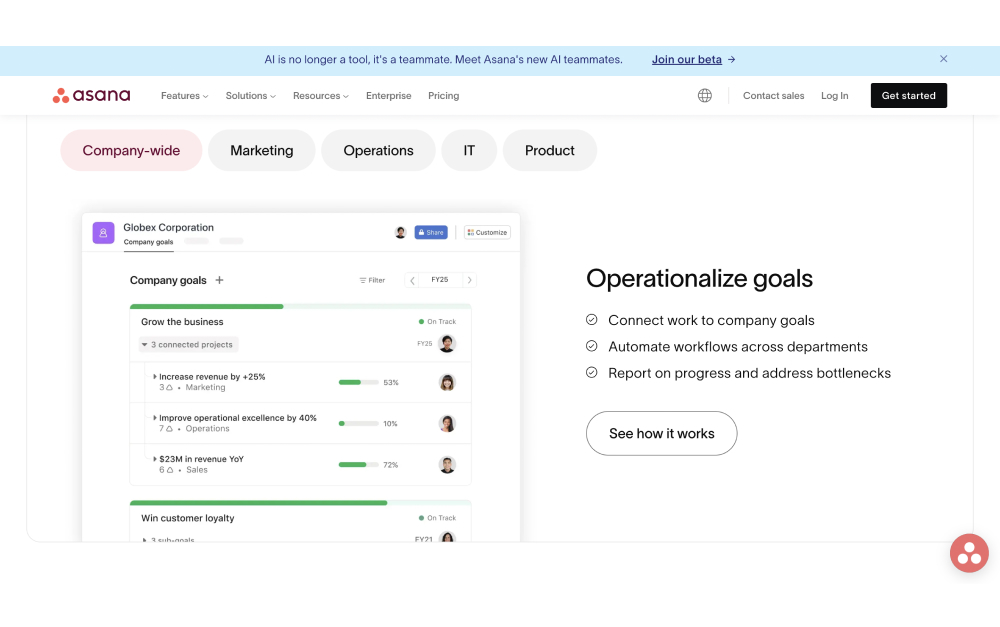
Asana launched in 2008 to solve one problem: who is doing what by when. The product has grown around that idea. Tasks have assignees, due dates, and dependencies. Projects bundle tasks into deliverables. Portfolios bundle projects into programs. Goals connect everything to outcomes. Custom fields, timelines, and reporting dashboards turn the data into something a project lead can actually run.
Asana also leaned hard into AI in 2025. Asana AI Studio and AI Teammates ship from the Starter plan and above, with monthly credit allotments scaling up by tier. The bet is that structured project data is exactly what AI agents need to do useful work. Reporting summaries, status updates, dependency suggestions, and risk flags become automatable when the underlying tasks already have rich metadata.
"Perfection is achieved, not when there is nothing more to add, but when there is nothing left to take away." - Antoine de Saint-Exupéry, Author of Wind, Sand and Stars
Saint-Exupéry's line captures both philosophies in a single sentence. Asana adds. Basecamp subtracts. Asana gives you everything a project lead might need and trusts you to use the parts that matter. Basecamp gives you a small set of features and trusts that you do not actually need the rest. For the wider Asana field, see our Asana alternatives guide and the what is Asana explainer.
What Basecamp is built for
Basecamp has been around since 2004 and has stayed close to one idea: project management should be calm. Each project gets a message board, to-do lists, a schedule, a chat room (Campfire), real-time pings, file storage, and Hill Charts for visualizing progress. The features are deliberately limited. There is no Gantt chart with cross-task dependencies, no time tracking on the base plan, and no native AI.
That last point is intentional. 37signals, the company behind Basecamp, has been openly skeptical of bolting AI features onto every product. In late 2025, founder DHH wrote about Basecamp becoming agent-accessible. The reframe was direct. Instead of baking AI features in, 37signals revamped the API and added a CLI so external agents can drive Basecamp. The bet is that users will want to choose their own AI rather than have one chosen for them.
"Basecamp is a communication tool with some task management abilities, as well as the ability to host add-ons with some interesting uses." - Fergus O'Sullivan, Cloudwards
Most reviews frame Basecamp as Cloudwards does: a communication tool with task management bolted on. That framing misses the point. Basecamp's simplicity is intentional, not a gap. The features are subtractive by design. Card Tables (lightweight Kanban) shipped in 2024. Hilltop View, which aggregates Hill Charts across projects, shipped in 2025. Each release adds one or two things and stays within the calm framework. Teams that want to onboard freelancers and clients without training appreciate that finished-product feel. Teams that want a power tool find it limiting. For the wider field, see our Basecamp alternatives guide.

Asana vs Basecamp side-by-side
Five axes matter when picking between these tools. Philosophy, tasks and PM, communication, AI in 2026, and pricing. Here is how each one stacks up.
| Feature | Asana | Basecamp |
|---|---|---|
| Philosophy | Structured PM, hierarchy first | Opinionated finished product, calm by design |
| Best for | Project-led teams with timelines and dependencies | Async PM with built-in messaging, client services |
| Tasks and PM | Tasks, projects, portfolios, goals, timelines, custom fields, workload | To-dos, schedules, Card Tables (Kanban), Hill Charts |
| Built-in chat | Comments only, no real-time chat | Yes (Campfire group chat plus Pings for one-on-ones) |
| Docs and wiki | Project Briefs and rich text in tasks, Knowledge Base on Advanced | Message boards and Docs and Files (basic) |
| AI in 2026 | AI Studio + AI Teammates from Starter ($10.99/user/mo) | None native (deliberate). Agent-accessible API + CLI |
| Free plan | 2 users max, unlimited tasks and projects | 1 project, 3 users, 1GB storage |
| Paid from | Starter $10.99/user/mo, Advanced $24.99/user/mo (annual) | Plus $15/user/mo, Pro Unlimited $299/mo flat (annual) |
| Client access | Guests on paid plans, count toward seat limits at full access | Built-in Clientside view that hides internal threads |
| Mobile | Strong, full feature parity | Strong, native iOS and Android apps |
| Learning curve | Moderate, structured templates help | Minimal, opinions are baked in |
Philosophy: power tool vs calm finished product
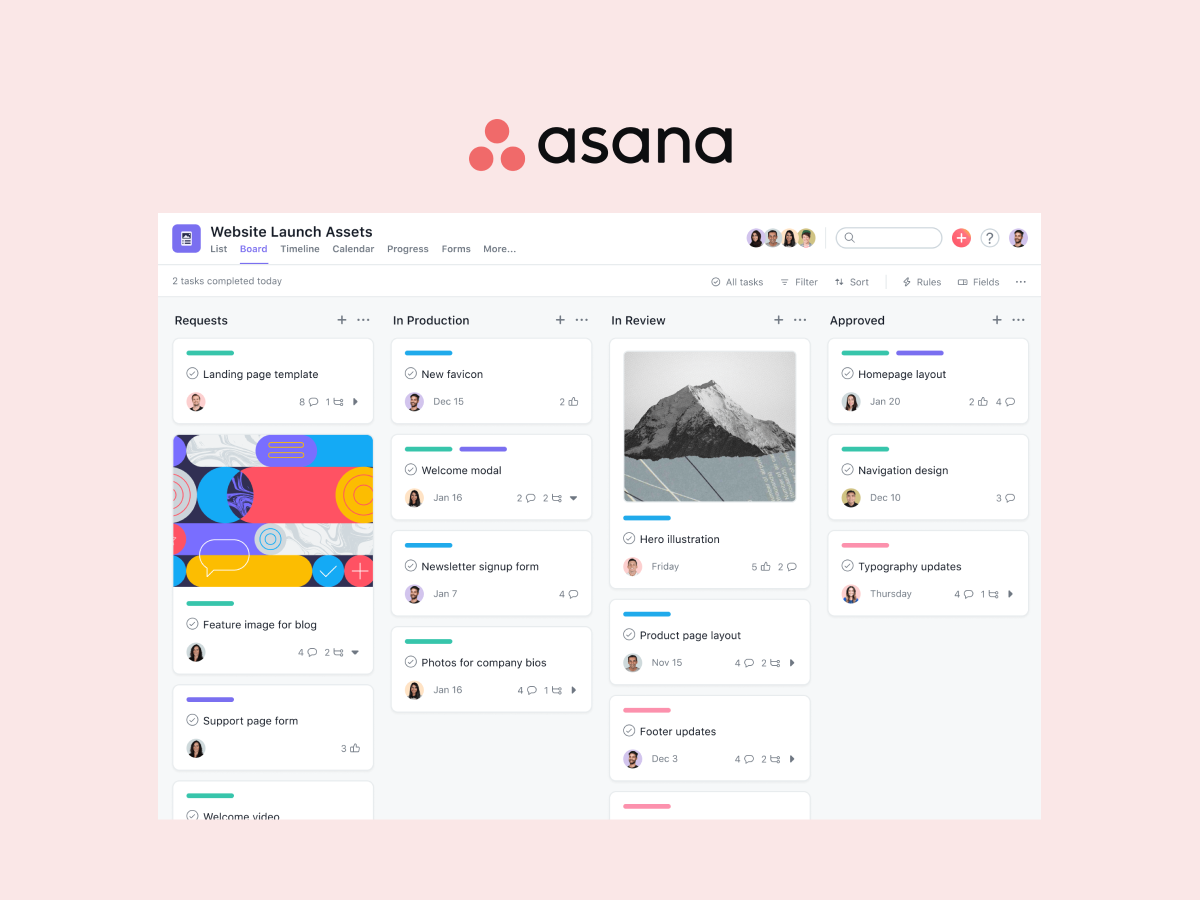
This is the spine of the Asana vs Basecamp comparison. Asana arrives with structure and a wide feature set. Tasks have first-class assignees, due dates, dependencies, custom fields, subtasks, and 5 project views (list, board, timeline, calendar, dashboard). New teammates open it and see the full toolbox.
Basecamp arrives with opinions. To-dos, schedules, message boards, Campfire chat, file storage, Hill Charts. The feature set is decided. The layout is fixed. New teammates open it and know where to write a status update, where to add a to-do, where to start a chat. Onboarding takes minutes.
For project leads who want to model dependencies and run formal portfolio reviews, Asana wins. For agency owners onboarding freelancers and clients across time zones, the finished-product model wins.
Tasks and project management
Asana wins this axis on raw capability. Timelines (Gantt), dependencies, workload, and reporting dashboards ship out of the box. Custom fields turn task lists into structured databases. Portfolios roll project-level status into program-level visibility. None of this needs setup beyond naming things.
Basecamp covers the basics differently. To-dos handle simple task tracking. Card Tables (added in 2024) cover lightweight Kanban. Schedules handle dates. Hill Charts visualize progress along uphill and downhill phases of work. There is no native Gantt chart, no resource workload view, and no time tracking on the standard tier. Teams that need formal project management will hit a wall in Basecamp within months.
If your work needs Gantt charts and dependencies, Asana is the cleaner fit. If your work fits inside calm to-dos and message boards, Basecamp is the cleaner fit. For the broader category, see our task management apps roundup.
Communication and collaboration
Basecamp wins this axis decisively. Campfire group chat and Pings (one-on-one DMs) are first-class features, not afterthoughts. The message board format encourages thoughtful written updates instead of rapid-fire chat. Clientside view hides internal threads from clients on the same project. The whole product is shaped around how teams actually communicate during work.
Asana has comments on tasks. There is no real-time chat, no DMs, no group chat surface. Teams that pick Asana usually pair it with Slack or Teams for the chat layer, which means another tool, another seat fee, and another place where decisions disappear. The Asana Inbox helps, but it is a notification feed, not a conversation surface.
This wedge matters for client-services teams. If clients need to message you mid-project, Basecamp keeps them inside the project. Asana sends them to your inbox or your Slack. That choice cascades through the whole engagement.
AI in 2026
This is the cleanest philosophical split between the two products. Asana went all-in. AI Studio and AI Teammates ship from the Starter plan ($10.99 per user per month annual). The credit allotment scales with tier: 50K credits on Starter, 75K on Advanced, 200K on Enterprise. Use cases lean toward project automation: status summaries, risk flags, dependency suggestions, smart routing of incoming work.
Basecamp went the opposite direction. 37signals deliberately ships no native AI features. The company has stated that they experimented with AI internally and chose not to ship most of what they built because it was not actually useful. Their public bet is on agent-accessibility instead: a revamped API and CLI so external agents (Claude, ChatGPT, Cursor, others) can drive Basecamp from the outside. Users bring their own AI rather than have one chosen for them.
Most ranking comparison articles have not caught up with this split. If AI is part of how your team works, Asana's bundled approach is the smoother experience. If you want to choose your own AI tools (or pay for none), Basecamp's stance is more aligned with how you operate.
Pricing model
This is where the math gets interesting. Asana uses per-user pricing only. Starter is $10.99 per user per month on annual billing. Advanced is $24.99. Pricing details on asana.com/pricing.
Basecamp uses two pricing models. Plus is $15 per user per month, which favors small teams. Pro Unlimited is a flat $299 per month (annual) or $349 per month (monthly billing) for unlimited users, which favors teams above 20 people. Pricing details on basecamp.com/pricing.
Worth flagging: Asana's free tier was reduced to 2 users in 2025. Teams that joined Asana on the old 10 to 15-user free tier face an upgrade cliff. Basecamp's free tier covers 1 project, 3 users, and 1GB storage. The headline math at scale depends on team size, and we model that next.
Real cost at 5, 15, 30, and 50 seats
Most comparison articles model 50 or 100 seats and stop. Below is the verified annual cost at 5, 15, 30, and 50 seats using 2026 list prices on annual billing. Rock is included as a flat-rate reference because the math gets interesting at the larger sizes.
| Team size | Asana Starter | Asana Advanced | Basecamp Plus | Basecamp Pro Unlimited | Rock Unlimited |
|---|---|---|---|---|---|
| 5 people | $659 | $1,499 | $900 | $3,588 | $899 |
| 15 people | $1,978 | $4,498 | $2,700 | $3,588 | $899 |
| 30 people | $3,956 | $8,996 | $5,400 | $3,588 | $899 |
| 50 people | $6,594 | $14,994 | $9,000 | $3,588 | $899 |
Three things stand out. First, Asana Starter is the cheapest paid option below 8 people, and Asana Advanced doubles the cost of Starter at every size. Second, Basecamp Pro Unlimited at $3,588 per year stays flat regardless of team size. That makes it cheaper than Basecamp Plus once you cross 20 people, and saves ~$11,406 per year vs Asana Advanced at 50 seats. Third, Rock at $899 per year is cheaper than every option except Asana Starter at 5 people, and from 7 seats up Rock is cheaper than Asana Starter too.
"Most non-specialized tools lack project-focused features such as task dependencies, resource allocation, or time tracking. Teams end up using multiple apps, increasing admin work and chances for error." - Gartner Digital Markets, Project Management Buyer Insights
Gartner's framing is the honest version of the trade-off. Pick Asana for power, pay for it per seat. Pick Basecamp for calm and chat, get flat pricing once you scale. The wrong tool is wrong regardless of price, but Asana vs Basecamp is one of the few comparisons where the pricing model itself shapes the decision.
When to pick Asana
Asana is the right pick for teams that run formal projects with deadlines, dependencies, and reporting. Some specific cases.
Project-led teams with timelines and dependencies. Marketing campaigns, product launches, client deliverables with multi-step approvals. Asana's Gantt-style timeline view and dependency tracking turn the project lead role from babysitter to coordinator.
Teams that need portfolio visibility. Operations leaders running 10 to 30 active projects across teams. Portfolios roll up status, owners, and progress without manual aggregation.
Teams that want native AI for project work. AI Studio and AI Teammates from the Starter plan are meaningfully cheaper than building the same automation around a flexible workspace.
Teams larger than 15 with budget for per-seat pricing. Asana Advanced at $24.99 per user gets expensive fast, but the feature set (workload, goals, proofing) earns its keep on complex programs.
Skip Asana if. You want chat as a core surface in your PM tool. You want a flat-rate price. Or your team will not use formal PM features and will live in the task list and chat instead.
When to pick Basecamp
Basecamp is the right pick for teams that want calm, opinionated PM with chat included. Some specific cases.
Async-first agencies and consultancies. The message board format encourages thoughtful written updates instead of rapid-fire chat. Hill Charts give a sense of progress without daily status meetings. The whole product is shaped around how async teams actually work.
Teams that bring clients into projects. Basecamp's Clientside mode hides internal threads and gives clients a curated view of project progress. The flow is built in, not bolted on. For agencies that ran into Asana's guest-seat fees, Basecamp is a relief.
Teams that prefer no AI. If you want a tool that does not push you to use AI features, Basecamp is rare in the modern PM market. The 37signals stance on AI is genuine, not marketing.
Teams larger than 20 with a flat-rate preference. Pro Unlimited at $3,588 per year covers any number of users. At 50 people, that is ~$11,406 per year cheaper than Asana Advanced. The savings buy a lot of other things.
Skip Basecamp if. You need formal project management with Gantt charts and dependencies. You write more than you ship and need a deep wiki. Or you want native AI as part of the daily flow.
Or skip the choice entirely.
Rock combines chat, tasks, and notes in one workspace. Free for small teams.
When you should not pick either
Both tools come from earlier eras of building specialized productivity tools. Asana picked PM and went deep. Basecamp picked calm and stayed disciplined. Neither was built around the chat-first workflow that agencies, client-services teams, and remote teams in Latam, SEA, and Africa actually run on.
If your team starts work in WhatsApp, Slack, or a group chat, decisions land in chat first. Translating those decisions into Asana tasks or Basecamp to-dos later loses half the context. The fix is a tool where chat, tasks, and notes live in the same space.
Rock is built that way. Every project space has its own chat, task board, notes, and files. Decisions made in chat become tasks with one tap. Files attach to the task or note that needs them. Clients and freelancers join the same space at no extra cost. Pricing is flat at $89 per month for unlimited users, which crosses Asana Starter at 7 people and is always cheaper than Basecamp Pro Unlimited. For agencies running 5 to 50 people across client projects, the math and the workflow both line up.
Direct comparisons: Rock vs Asana, Rock vs Basecamp. For sibling head-to-heads, see Asana vs Notion, Asana vs Jira, Basecamp vs Notion, Basecamp vs Monday, and ClickUp vs Basecamp.
Frequently asked questions
Is Basecamp still relevant in 2026? Yes, for the right team. The 37signals philosophy of intentional simplicity has aged well. Card Tables (2024) and Hilltop View (2025) show ongoing investment. The product is not chasing AI features, which is a feature for some teams. Where Basecamp falls short is teams that need formal PM with Gantt and dependencies.
Does Asana have built-in chat? No. Asana has comments on tasks and an Inbox notification feed, but no real-time chat, DMs, or group chat. Most teams pair Asana with Slack or Teams for the chat layer, which adds another tool and another seat fee.
Can Basecamp replace Asana for formal project management? For small teams running simple projects, yes. For teams that need timelines, dependencies, workload, or portfolio reporting, no. Basecamp's PM is opinionated and limited by design. Pushing it into formal PM territory will frustrate the project lead within weeks.
Are Asana AI and Basecamp's no-AI stance both real positions? Yes. Asana shipped AI Studio and AI Teammates from the Starter plan in 2025 and continues investing. 37signals (Basecamp) has publicly said they will not bake AI features in and instead made the API agent-accessible so users can bring their own AI. Two genuinely different bets.
If chat, tasks, and notes belong together for your team, see how Rock works. Rock combines all three in one workspace. One flat price, unlimited users. Get started for free.