What is Asana? Pros, Cons & Honest Review (2026)
Asana is a work management platform built around tasks, projects, and portfolios instead of documents or chat. Founded in 2008 by Dustin Moskovitz and Justin Rosenstein, it went public on the NYSE in 2020 and now serves more than 170,000 customers worldwide.
If you are researching what Asana is in 2026, the short answer: it is the most mature of the big-three task tools (alongside ClickUp and Monday.com), focused on tracking the work rather than chatting about it. Dan Rogers took over as CEO in July 2025 after Moskovitz retired, and the company is leaning into AI Studio agents.
This guide covers what Asana actually does, what it costs in 2026, where it shines, and when you should pick something else. No marketing spin.
A quick lens before the breakdown. The way teams manage work has shifted in the last few years. With AI assistants like ChatGPT or Claude moving things faster, building and tracking every task by hand pays off less than it did. What helps more is staying connected to the systems where the work already happens. Keep that in mind as you weigh what Asana is built to do.
Asana vs Popular Alternatives (2026)
Here is how Asana compares against the tools most teams evaluate alongside it.
| Tool | Best For | Free Plan | Paid From |
|---|---|---|---|
| Asana | Structured projects, Goals, Gantt | 2 users | $10.99/user/mo |
| Rock | Chat + tasks, flat pricing | 3 spaces, 5 members | $89/mo flat |
| ClickUp | All-in-one, deep customization | Unlimited members | $7/user/mo |
| Monday.com | Visual boards and automations | 2 seats | $9/seat/mo (3-seat min) |
| Trello | Simple Kanban boards | Unlimited boards | $5/user/mo |
What Asana Actually Does
At its core, Asana tracks work as tasks inside projects. Each task can have subtasks, assignees, due dates, custom fields, and dependencies. Projects live inside teams, and teams roll up into portfolios for executive visibility.
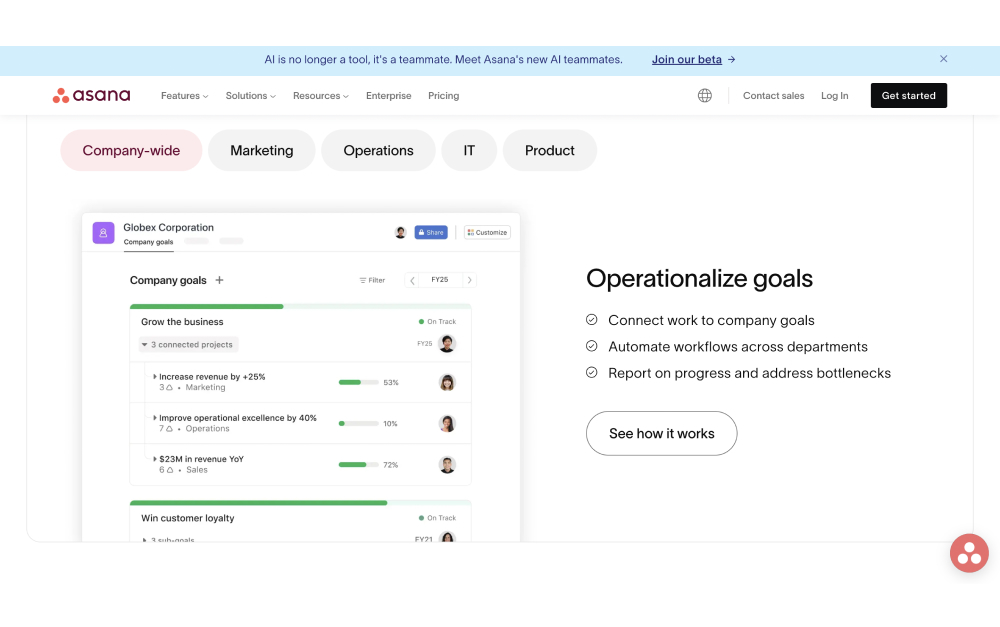
The standout features for most buyers are the multiple views. Any project can be displayed as a list, Kanban board, timeline (Gantt), calendar, or workload chart without extra setup. Goals link company-level OKRs to the tasks that move them.
Workflow Builder handles no-code automations like "when a task moves to Review, assign it to the manager and set the due date." Forms capture intake requests. Asana AI Studio, which became standard on paid plans in mid-2025, lets teams build credit-metered agents that summarize updates, draft status reports, and route work automatically.
Integrations cover the obvious suspects: Salesforce, Slack, Google Workspace, Microsoft 365, Tableau, Power BI, and 300+ others through the Apps directory.
Asana Pricing in 2026
Asana's pricing sits in four tiers, verifiable at the Asana pricing page.
Personal: Free. Up to 2 users. Unlimited tasks, list and board views, assignees, due dates. Fine for a solo planner or a pair.
Starter: $10.99 per user per month annual, $13.49 monthly. Unlimited users, timeline view, forms, Workflow Builder, and the Asana AI Studio Basic tier. G2 reviewers report a 5-seat minimum surfaces at checkout, which is worth verifying before signing up.
Advanced: $24.99 per user per month annual, $30.49 monthly. Adds Goals, Portfolios, time tracking, workload, approvals, and the features most mid-size teams actually need.
Enterprise and Enterprise+: Custom pricing. SSO/SAML, advanced guest controls, data residency, and 200k AI Studio credits per month.
The pricing cliff is real. Jumping from Starter to Advanced more than doubles your bill per user, and several of the features small teams want (time tracking, Goals, Portfolios) are gated to Advanced.
Asana Starter
What it costs as your team grows
Monthly cost
$1,978 per year
Annual billing. Advanced tier (Goals, time tracking, Portfolios) is $24.99/user/month. 5-seat minimum reported at checkout.

Looking for a flat-priced alternative?
Rock combines tasks with chat and notes in one workspace. One flat price, unlimited users.
Where Asana Excels
View flexibility. List, board, timeline, calendar, and workload are all native. You do not need to pick a metaphor. Teams with mixed styles usually find something that fits.
Workflow Builder and Rules. Non-technical ops teams can build real automations without scripts. Forms, approvals, and multi-step rules hold up at scale.
Portfolio and Goal alignment. At Advanced and above, Goals link OKRs to the tasks that move them. Portfolios give executives a clean rollup across dozens of projects.
Stability. Of the big three (Asana, ClickUp, Monday.com), Asana has the fewest performance complaints. It loads fast, handles large workspaces, and does not break under load.
"At work, we're at our best, that is, effective, fulfilled, and happy, when we're engaged in tasks that are distinctly human." - Dustin Moskovitz, Asana Co-founder and Board Chair
The Honest Trade-offs
Per-user pricing gets expensive. The jump from Starter ($10.99) to Advanced ($24.99) is steep, and the features most mid-size teams need live in Advanced. A 50-person team on Advanced pays $15,000 a year.
Guest collaboration is restrictive. External guests on lower tiers can invite other guests with no admin control until Enterprise. Rock's cross-org collaboration is simpler and clients join shared spaces at no extra cost. This is a real pain point for agencies and professional services.
Chat and docs are not first-class. Asana is task-first. You still need Slack or Teams for conversations and Notion or Google Docs for knowledge. For broader options on the docs side, see our Notion alternatives guide. That tool sprawl is why some teams look for an all-in-one alternative. Rock combines chat, tasks, and notes in the same workspace at a flat $89 per month.
Market signals are mixed. Asana's stock is down about 60% year over year, net retention dropped to 96%, and the company laid off roughly 9% of staff in early 2025. These are not product defects, but they are signals worth noting when betting on a platform.
Learning curve versus simpler tools. Reviewers consistently note that subtask management and customization take time to master. If your team just needs a shared to-do list, Trello, Basecamp, or Todoist will feel faster.
"The high-level goal of No Meeting Wednesdays is to ensure that everyone gets a large block of time each week to do focused, heads-down work." - Dustin Moskovitz, Tim Ferriss Show interview
What we do at Rock: we run every client project in a shared space with chat, tasks, and notes side by side. When a message becomes work, we turn it into a task in one click. Clients join for free, so we avoid the guest-seat math Asana teams constantly manage.
Or pick the chat-first alternative.
Rock pairs tasks with messaging and notes. Free for small teams.
Who Asana Is Really For
Best for: marketing, operations, and professional services teams of 20 to 200 that want structured projects with strong Gantt and workload views. Cross-functional orgs tracking Goals and Portfolios at the Advanced tier see real value.
Skip Asana if: you are a lean team under 10, you need heavy client-side collaboration, or you need chat and tasks in the same place. The Starter-to-Advanced price jump makes Asana painful for small teams, and the guest model frustrates client-heavy shops.
Related Reading
If Asana is in the shortlist but not the obvious winner, a few cluster reads cover the adjacent questions.
Comparing other PM tools? See our honest reviews of ClickUp and Monday.com.
Asana vs Trello. The Asana vs Trello head-to-head covers when simple Kanban beats full PM depth.
ClickUp vs Asana. The ClickUp vs Asana head-to-head covers the depth vs clarity decision.
Asana vs Monday. The Asana vs Monday head-to-head covers structured PM vs configurable Work OS.
Explore alternatives. Our Asana alternatives guide compares 10 options across budget and team size.
Asana versus other PM tools. The best task management apps post walks through 10 tools head to head.
Rock versus Asana. For the direct comparison, see Rock vs Asana.
Asana covers all your needs when it comes to planning. The synchronous communication your team relies on, though, comes second in its overall product design. That is the real trade-off to weigh: deep planning structure, with team chat as a secondary concern.
If you are weighing Asana against a tool that combines chat, tasks, and notes, Rock bundles them in one workspace. One flat price, unlimited users. Get started for free.